

Dudley Local Plan Part One
18. Minerals
Introduction
18.1Local plans are expected to make sufficient provision for all kinds of development, including for minerals (NPPF). The policies for minerals support the strategic objectives of the Plan.
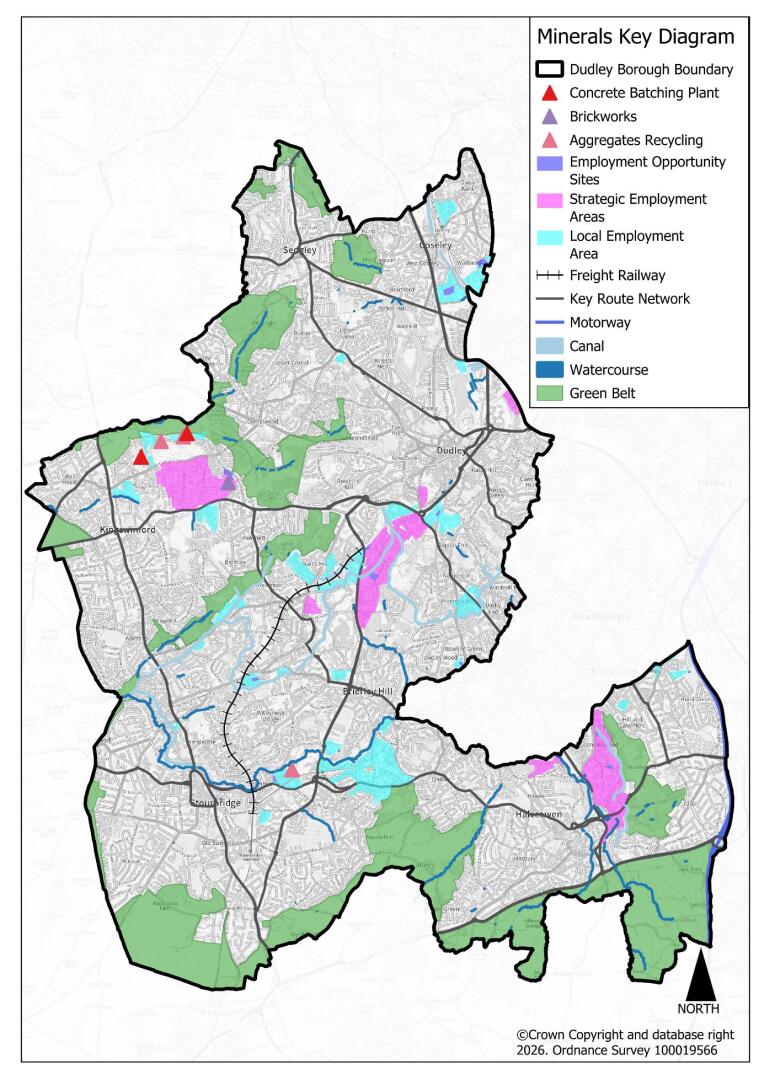
18.2This policy reflects the fact that there are no remaining workable primary minerals resources within Dudley Borough (as identified in the supporting Black Country and Dudley Borough Minerals Studies). The focus is upon the boroughs’ secondary and recycled aggregates supply and continuing to work jointly with other Minerals Planning Authorities to consider any strategic matters arising from the likely demand for minerals over the Plan period. Continued joint working (for example as part of the West Midlands Aggregates Working Party) will serve to address any matters arising from the imports of minerals from other areas into the borough.
Policy DLP74 Mineral Production - Requirements
- To address strategic matters related to the supply of minerals, the Council will continue to work with relevant local authorities and other stakeholders (including via the West Midlands Aggregate Working Party) and will contribute to the publication of Local Aggregates Assessments for the West Midlands Metropolitan Area. To enable Dudley Borough to make an appropriate contribution towards local and regional minerals requirements, the following provision is identified for minerals over the Plan period.
Construction Aggregates - Secondary and Recycled Aggregates
- The supporting evidence base identifies the estimated quantity of secondary and recycled aggregates per annum being produced at permitted production sites within the borough (Dudley Minerals Study, 2023). The Council will aim to maintain and increase this level of production throughout the Plan period. In support of this, permitted secondary and recycled aggregates sites currently expected to continue in production up to 2041 will be safeguarded (see Policy DLP75). Permitted and future waste sites which function as secondary and recycled aggregates sites are also safeguarded via Policy DLP71. Proposals for new developments that will function as waste and minerals sites will be considered positively taking account of Policy DLP72 and Policy DLP76.
Efficient Use of Mineral Resources
- All new developments should be as resource-efficient as possible, by making the maximum possible use of recycled mineral products in construction, to reduce reliance of quarried products and help maintain existing supplies for longer (see also Policy DLP73).
Justification
18.3 The NPPF recognises that mineral resources can only be worked where they are found. As detailed in the Black Country and Dudley Minerals Study’s (2020 and 2023), there are no primary aggregates sites remaining in the borough. Therefore, the focus of the policy is on the supply of secondary and recycled aggregates which helps to preserve the regional primary aggregates supply.
18.4 Secondary and recycled aggregate sites expected to continue in production up to the end of the Plan period will be safeguarded (see Policy DLP75). Due regard should also be had to the relevant Dudley Local Plan waste policies (notably Policies DLP70 and DLP71).
18.5Coventry, Dudley, Sandwell, Solihull, Walsall, and Wolverhampton. The Council will continue to work with these Mineral Planning Authorities in terms of identifying, monitoring and managing the wider WMMA minerals requirements over the plan period. The Council will also continue to work with Mineral Planning Authorities in the wider region, via the West Midlands Aggregate Working Party.
18.6There is one tile work business in the borough (Dreadnought) which is reliant on brick clay imports from Staffordshire. Via joint working as part of the WMMA and the West Midlands Aggregate Working Party, the Council will seek to monitor and manage the supply of imports necessary to serve such sites.
Evidence
- Black Country Minerals Study (2020), Wood
- Dudley Borough Minerals Study (2023), WSP
Delivery
- Planning applications and permissions
- Continued cooperation and liaison with WMMA authorities and wider Minerals Planning Authorities i.e., via the Local Aggregates Assessment and the Aggregates Working Party
Minerals Safeguarding
18.7 The evidence base has not identified any parts of Dudley Borough that merit being designated as Minerals Safeguarding Areas (MSA - i.e., any workable primary mineral resources). The policy is therefore focused upon how larger scale developments across the borough can prevent the unnecessary sterilisation of mineral resources more widely (outside of MSAs).
18.8 This policy sets out how mineral sites that are expected to be producing, processing or transporting minerals and mineral products within Dudley Borough (primarily secondary and recycled aggregate sites in the borough context) will be protected from other types of development that could compromise their continued operation over the plan period.
Policy DLP75 Minerals Safeguarding and Minerals Processing/Infrastructure Sites
- Mineral deposits that are identified as being, or may become of, economic importance will be safeguarded from unnecessary sterilisation.
- Where non-mineral development is proposed, consideration should be given to the extraction of any identified mineral resource prior to or in conjunction with, development, where this would not have unacceptable impacts on neighbouring uses. This applies to developments over five hectares (for new building development only, i.e., excluding changes of use and conversions). Such developments should be accompanied by supporting information (as set out in the Justification) demonstrating that mineral resources will not be needlessly sterilised.
- The location of currently permitted mineral infrastructure sites are identified on the Minerals Key Diagram and are listed in the ‘Justification’ below. Applications for development near these sites (generally within 150 metres) will need to demonstrate they will not have any unacceptable impacts on these sites that would prevent them from continuing to operate. Any new mineral infrastructure sites which come forward during the plan period will also be subject to these policy provisions.
Justification
18.9Most of Dudley Borough’s primary mineral resources are now either exhausted or sterilised by other development and are therefore not capable of being worked on a commercial scale. Therefore, the plan does not identify any Minerals Safeguarding Areas (MSAs). However, to prevent the unnecessary sterilisation of minerals resources more widely, the prior extraction of these resources is encouraged where large scale non-mineral development is proposed (except for conversions /changes of use that do not involve any new building or excavation works) in accordance with the NPPF.
18.10Mineral sterilisation issues will only generally come into play when larger development sites are concerned i.e., those generally above five hectares, and such developments should be accompanied by supporting information demonstrating that mineral resources will not be needlessly sterilised. The supporting information should include details of a prior extraction scheme or, where this is not considered feasible, evidence that:
- mineral resources are either not present, are of no economic value or have already been extracted as a result of a previous site reclamation scheme or other development; or
- extraction of minerals is not feasible, for example due to significant overburden or because mineral extraction would lead to or exacerbate ground instability; or
- prior extraction of minerals would result in abnormal costs and / or delays which would jeopardise the viability of the development; or
- there is an overriding need for the development which outweighs the need to safeguard the mineral resources present; or
- extraction of minerals would have unacceptable impacts on neighbouring uses, the amenity of local communities or other important environmental assets.
18.11 Where prior extraction is proposed, conditions will be imposed on any grant of permission requiring applicants to provide details of the types and tonnages of minerals extracted once the scheme has been completed.
18.12 The Plan must make provision for mineral sites and associated mineral infrastructure sites (in accordance with the NPPF). As such, existing mineral sites and mineral infrastructure sites need to be safeguarded for continued use and to retain the potential of the areas in which they occur.
18.13 The Black Country Minerals Study identifies ‘buffer zones’ around existing mineral extraction and mineral infrastructure sites. Given the proximity of permitted mineral sites to existing development in the borough, it is considered that the application of the Mineral Products Association’s recommended 250m buffer zone around every existing mineral site is unrealistic. A 150m buffer has been applied instead. Any non-mineral development within this 150m buffer zone will need to demonstrate it will not have any unacceptable impacts on these sites that would prevent them from continuing to operate.
18.14 The currently permitted mineral processing and infrastructure sites (permanent planning permission) are detailed in Tables 18.1 and 18.2 below.
Table 18.1 Mineral Processing Sites in Dudley Borough
|
Local Plan Site Ref |
Previous Local Plan Ref |
Site Name |
Location |
Use |
|---|---|---|---|---|
|
MS1 |
n/a |
Dreadnought Brickworks |
Dreadnought Road, Pensnett |
Operational brickworks |
Table 18.2 Mineral Infrastructure sites in Dudley Borough
|
Local Plan Site Ref |
Previous Local Plan Ref |
Site Name |
Location |
Use |
|---|---|---|---|---|
|
MS2 |
n/a |
Accumix Concrete |
Ham Lane, Kingswinford |
Concrete Batching Plant |
|
MS3 |
n/a |
Bell Recycling Centre |
Oak Lane, Kingswinford |
Aggregates Recycling |
|
MS4 |
n/a |
Oak Lane Aggregates Recycling Site |
Oak Lane, Kingswinford |
Aggregates Recycling |
|
MS5 |
n/a |
Oak Lane (formerly SW Jackson Aggregates) |
Off Oak Lane, Kingswinford |
Concrete Batching Plant |
|
MS6 |
n/a |
Pegasus Skip Hire (formerly Regen R8 Limited) |
Timmis Road, Lye |
Aggregates Recycling |
Evidence
- Black Country Minerals Study (2020), Wood
- Dudley Borough Minerals Study (2023), WSP
Delivery
- Planning applications and permissions
- Developers- to consider the impact of proposed development on minerals resources and infrastructure
Managing the Effects of Mineral Development
18.15 This policy sets out the requirements that planning applications for mineral working and minerals infrastructure will be expected to address. The policy applies to both proposals at existing sites and those at new ones.
Policy DLP76 Managing the Effects of Mineral Development
- Proposals for new mineral working or mineral-related infrastructure at both new and existing sites should demonstrate how they contribute towards the strategic objectives of Policy DLP74. Proposals should meet the following criteria:
- Minimise and mitigate any adverse visual impacts.
- Minimise and mitigate adverse effects on natural and historic environments and on public health.
- Minimise and mitigate the generation of noise, dust, vibration, lighting, and vehicle movements.
- Minimise and mitigate any harm to water quality and resources and flood risk management and impacts upon the drainage network.
- Ensure any potential harm arising from ground conditions and land stability is satisfactorily investigated and resolved, in accordance with Policy DLP80.
- Land use conflict – proposals should demonstrate compatibility with the uses already present within the surrounding area (applying the ‘agent of change’ principle).
- Minimise and mitigate any adverse impacts on the highway and transport network.
- Where necessary, mitigation measures should be identified to reduce any adverse effects identified under criteria 1a-1g to an acceptable level.
Justification
18.16 The NPPF places several requirements on minerals planning authorities when setting policies for assessing minerals developments and for assessing individual proposals – including adverse impacts on the natural and historic environment and on human health, cumulative effects of multiple mineral facilities, control and mitigation of noise, dust and vibration, and restoration and aftercare at the earliest opportunity and to a high environmental standard.
18.17This policy sets out the general requirements that will apply to all proposals involving the development of mineral infrastructure and mineral working.
18.18 Mineral infrastructure proposals are defined as storage, handling, and processing facilities (such as depots and recycling facilities) and transportation facilities (such as rail sidings, rail heads and canal wharves). In the context of Dudley Borough, mineral working proposals are only likely to include any prior extraction in advance of a large-scale development scheme.
18.19 Mineral developments differ and early discussion with the mineral planning authority is recommended to clarify the scope and detail of information that will be required. It will be important that the applicant demonstrates the proposal to be consistent with national policy and the overall Spatial Strategy.
Evidence
- Black Country Minerals Study (2020), Wood
- Dudley Borough Minerals Study (2023), WSP
Delivery
- Planning applications and permissions
- Developers- to consider and satisfy the general requirements and additional assessment criteria set out in this policy when submitting minerals development proposals.
