

Dudley Local Plan Part One
9. Employment
Introduction
9.1The policies in this section are concerned with promoting and supporting employment in manufacturing, research and development (Use Class E(g)(ii), E(g)(iii) and B2), warehousing (Use Class B8) and other uses that are appropriately located in industrial employment areas. Offices (Use Class E(g)(i)) are not classed as an employment use for the purposes of these policies: instead they are covered by policies DLP24-DLP30, which relate to uses that are more appropriately located in town centres.
9.2An agenda for economic growth is reflected in the ambitions of the relevant national and regional strategic documents on this subject, especially:
- the National Planning Policy Framework (NPPF), which states that significant weight should be placed on the need to support economic growth and productivity, taking into account local business needs and wider opportunities for development, and that planning policies should set out a clear economic vision and strategy which positively and proactively encourages sustainable economic growth.
- the West Midlands Combined Authority (WMCA) “Plan for Growth (2022)” which states that WMCA will deliver economic growth through new powers over economic development, transport investment, investing in skills and working with investors, and committing to net zero targets, especially around suitable employment clusters, including aerospace, electric vehicles and battery technology, and logistics and distribution, delivered through levers for growth, including developing future skills pathways and securing direct competitive funding.
- the West Midlands Local Industrial Strategy (2019) which sets out a path for raising productivity via several key employment sectors.
9.3Previous economic growth strategies related to the former Black Country Local Enterprise Partnership (now defunct) such as the ‘Black Country Strategic Economic Plan’ (2014) and the ‘Black Country Economy of Together’ (2021) have effectively been subsumed by the regional WMCA strategies.
9.4This growth agenda, when transposed at a local (Dudley) level, underlies the importance of meeting borough wide employment land needs expressed in strategic targets, including the projected demand for jobs from existing and future working age residents. This builds on Dudley’s rich industrial heritage and adapting the existing portfolio of industrial land within the borough to provide the right environment, flexibility and interventions to encourage investment, especially in sustainable and progressive businesses. It provides a framework for meaningful long term employment opportunities and the creation of a prosperous, and economically strong and more sustainable borough.
9.5In recognition of the strong economic functional relationships between the Black Country Authorities, the Council has continued to work in partnership with the other Black Country Councils to update the economic evidence base (for the Functional Economic Market Area- see further details below). The evidence base for the employment land policies primarily consists of a four stage Economic Development Needs Assessment (EDNA), and the Black Country Employment Area Review (BEAR). The EDNA 2024 (update) provides an up-to-date objective assessment of the industrial land needs for the Black Country, apportioned between the Black Country Authorities to 2041, based upon an independent assessment of the area’s economic development needs.
9.6The key conclusions of the EDNA studies are:
- the Black Country is a clearly defined geographical unit, but with strong employment and labour market links to a hinterland that includes south Staffordshire, north Worcestershire, Birmingham, and Solihull.
- the Black Country has been hit hard by the COVID-19 recession but is expected to recover strongly and has the capacity to deliver significant growth, given the diversity, resilience and concentration of key national sectors located in the area.
- even pre-COVID19, recent growth was achieved against a backdrop of a weak local skills base, low business start-up rates and low GVA per head in comparison with the West Midlands and UK averages.
- the Black Country employment land supply in 2020 was largely that inherited from the Core Strategy and the suite of Tier 2 Plans which supported it and is dominated by small sites in the urban area.
- going forward, attracting high-growth knowledge-based industries in line with SEP ambitions will require the provision of more prestigious sites, high-quality space with easy access to key transport hubs and good connectivity.
- the Plan also needs to ensure that the Dudley Borough can accommodate a variety of business needs, including start-ups and smaller businesses - this means that a mixed portfolio of sites will need to be made available, including larger and smaller sites and spaces (including areas of both higher and lower specification).
- it is imperative to protect the existing supply of land to meet future needs that will arise from a high growth-driven economy.
- there is a significant gap between the employment land supply, inherited from the Core Strategy and subsequent Tier 2 Plans, and forecast future needs.
9.7To address these issues, the strategy that underpins the Employment Land Policies is made up of the following elements:
- to facilitate the growth and diversification of the economy, the Plan allocates land for new development within the Dudley Borough, to accommodate jobs and output growth (Policy DLP18).
- to accommodate a variety of business needs including high technology General Industrial (B2) and Storage and Distribution (B8) sectors, the Plan provides for a balanced portfolio of sites (Policy DLP18).
- to protect and enhance land and premises within existing employment areas where this provides for the needs of jobs and businesses (Policies DLP19, DLP20, DLP21).
- to recognise that some sites will become unsuitable for continued employment uses and to facilitate their redevelopment to alternative uses including housing (Policy DLP21).
- to enable local communities to share the benefits of economic growth (DLP23).
9.8In terms of Dudley’s specific employment land needs, the evidence contained within the latest Black Country Economic Development Needs Assessment (EDNA) 2024 provides an overall target figure for the Black Country area from 2020 to 2041 (571.6 hectares (ha) or 27.22 ha per annum) with the target figure for Dudley Borough being 90.57 ha or 4.31 ha per annum, this equates to 73.27 ha over the plan period of 2024 – 2041 however due to previous undersupply, the employment need for the plan period is 73.44ha.
9.9This target figure has been evidenced through past employment land completions between 2001-2020 and is based upon the high rate of past completions scenario. Review of market intelligence data in the last five years (i.e., employment land enquiries) indicates that for Dudley MBC it is the high rate of past completions scenario that better reflects demand trends for the future.
9.10The target figure of 73.44ha for Dudley (2024 to 2041) is based on past completions and, therefore, a split for General industrial (B2) uses and Storage and Distribution (B8) has not been given within the EDNA. However, based on assumptions made within OE forecasts, it is estimated that 23.50ha is required for manufacturing uses and 49.94ha is required for Storage and Distribution uses (based on 32% General Industrial and 68% Storage and Distribution).
9.11Within the EDNA, that overall employment land need figure for the Black Country is stated to increase to from 571.64ha to 634.7ha (2020-2041) to take on board the employment land lost as a result of planned redevelopment to alternative uses. In Dudley for 2024-2041, that total target figure of 73.44ha is increased to 92.13ha by adding in 18.63ha associated with those sites comprising existing operational employment land which are allocated for housing. The need for the replacement of such losses will be monitored as the Plan is implemented.
9.12It should be noted that Black Country EDNA is being updated to reflect the Plan period for the Wolverhampton Local Plan to 2042, and to ensure that the use of the economic modelling has regard to more recent census data and the most recent post covid economic data available.
9.139.13. The issue of strategic employment delivery across the wider West Midlands region has been explored through the West Midlands Strategic Employment Sites Study (WMSESS) 2023 (published September 2024). The WMSESS was commissioned by Dudley MBC on behalf of the West Midlands Study Area Local Planning Authorities and the West Midlands Combined Authority.
9.14The purpose of the WMSESS was to provide an updated position on currently committed strategic sites and identify the need for large scale strategic Storage and Distribution (B8) and General Industrial (B2) sites for the period up to 2045, whilst engaging with the private sector to gauge market demand and modern industry requirements.
9.15The WMSESS concluded that there was a considerable demand for strategic employment site opportunities across the region, and identified a number of broad opportunity areas which were considered to be appropriate growth locations to meet need arising from 2030’s to 2045.
9.16The study identified 14 road/rail opportunity areas, including opportunity areas around M6/M54 in South Staffordshire and M42/M5/A435 in Redditch and Bromsgrove.
9.17The recommendations from the Study will be used to inform Local Plan preparation, including the early review of relevant Plans.
9.18Based on the Study’s findings, it is not considered feasible for a strategic employment site (>25ha) to be allocated within the Dudley Borough. However, Dudley, along with other local authorities in the Black Country FEMA, will continue to engage with those neighbouring authorities who share a strong/moderate or evidence relationship with the FEMA to identify opportunities to bring forward strategic employment sites.
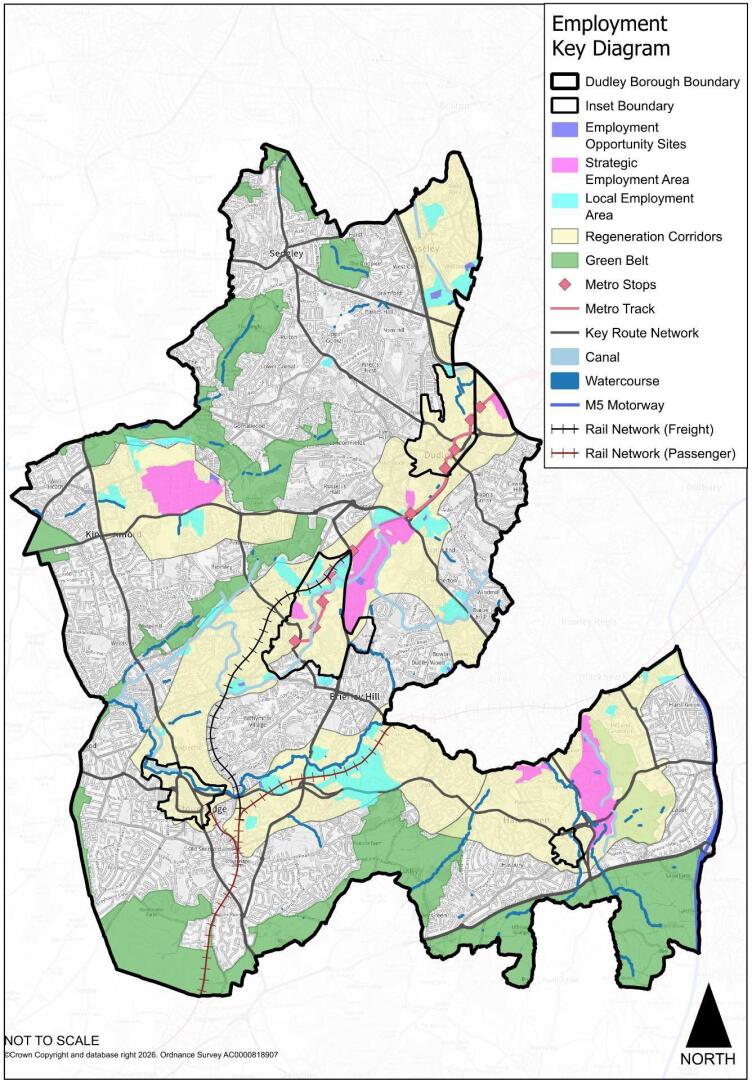
Figure 9.1 Spatial Strategy Plan: Employment
Providing For Economic Growth and Jobs
9.19This policy seeks to ensure a sufficient quantum of development opportunities are provided to meet the demand for economic growth and support the diversification of the Dudley economy.
Policy DLP18 Economic growth and job creation
- Dudley Council will seek to deliver at least 73.44 hectares of new employment land between 2024 to 2041 through:
- the development of Employment Opportunity Sites allocated within this Plan, equal to 10.78 ha.
- the redevelopment, intensification, conversion and enhancement of existing employment areas and premises, including the development of small opportunity sites (sites between 0.25 ha and 0.4 ha) also known as ‘windfall sites’.
- The plan will deliver a portfolio of sites of various sizes to meet a range of business needs, with an emphasis on the development of sites to support growth of the borough and future demand.
- The following allocated Employment Opportunity Sites, as shown on the Policies Map, will be safeguarded for employment uses within Use Classes E(g) (ii), E(g) (iii), B2 and B8:
|
DLP Site Ref |
DLP Site Name |
Indicative capacity (employment land floorspace sqm) |
Net site area (Ha) |
|---|---|---|---|
|
DLPE01 |
Fountain Lane/ Budden Road, Coseley |
5000 |
1.79 |
|
DLPE02 |
Tansey Green (south) |
6600 |
1.66 |
|
DLPE03 |
Hillcrest Business Park, New Road |
1600 |
0.42 |
|
DLPE04 |
Narrowboat Way |
5000 |
1.43 |
|
DLPE05 |
Steelpark Road, Halesowen |
2700 |
0.44 |
|
DLPE06 |
Bean Road, Coseley |
4000 |
2.16 |
|
DLPE07 |
Westminster Industrial Estate, Cradley Road, Netherton |
1600 |
0.48 |
|
DLPE08 |
Land off Amber Way, Coombeswood Industrial Park |
1800 |
0.45 |
|
DLPE09 |
Land adjacent to railway, Pedmore Road, Blackbrook Salvage |
3700 |
0.93 |
|
DLPE10 |
Hardstanding area south of Silver End Trading Estate |
1700 |
0.43 |
|
DLPE11 |
Land off Timmis Road, Lye |
2300 |
0.59 |
- The council will support the regeneration and renewal of designated Strategic and Local Employment Areas and, as appropriate, Other Employment Areas, with a focus on those Local Employment Areas which are located within designated Regeneration Corridors on the Policies Map, to enable Dudley Borough’s employment areas to be fit-for-purpose in the long term, and to grow and rejuvenate the local economy, especially through:
- environmental enhancements.
- access improvements, including for pedestrians and cyclists.
- the incorporation of renewable energy measures, and, as appropriate, installations measures and/or facilities which contribute towards a circular economy approach.
- the marketing and promotion of employment areas, and
- with particular regard to Local Employment Areas, opportunities to enable those areas to be more open to, and inclusive of, the local communities which they serve.
Justification
9.20The NPPF specifically states that for forecasting future trends:
- Plan makers should consider forecasts of quantitative and qualitative need (i.e. the number of units and floorspace for other uses needed) but also its unique characteristics (e.g. the footprint of economic uses and proximity to infrastructure), with the key output being an estimate of the scale of future needs, broken down by economic sectors.
- Local authorities should develop an idea of future needs based on a range of data that is current and robust. Authorities will need to take account of business cycles and make use of forecasts and surveys to assess employment land requirements.
- Emerging sectors that are well-suited to the area being covered by the analysis should be encouraged where possible - market segments should be identified within the employment land under consideration.
- The available stock of land should be compared with the particular requirements of the area so that gaps in local land provision can be identified.
9.21To contribute towards meeting the evidenced need for Dudley of 73.44ha of land for employment development for the period up to 2041, the Plan allocates 10.78ha of employment land for the period between 2024 – 2041, identified as Employment Opportunity Sites (EOS) on the Policies Map. To ensure that such sites make an effective contribution towards meeting needs, EOS shall be safeguarded for industrial employment uses within Use Classes E(g) (ii), E(g) (iii), B2 and B8, with consideration given to restricting development to those suitable uses through the application of appropriate planning conditions.
9.22Further contributions to the supply of land to meet that need are likely to come forward through the redevelopment, intensification, conversion and enhancement of existing employment areas and premises, including the development of small opportunity sites (sites between 0.25 ha and 0.4 ha). However, while small sites can provide a constant supply of developable land, in overall terms, historically they have shown to have made a limited contribution to the delivery of overall development needs, and the availability of such sites can also be difficult to predict. As set out in the EDNA (2024) there is an assumption that small sites (less than 0.4ha) can deliver at least 1.22ha, giving a total supply of 12.46ha. This source could yield further supply over the Plan period and will be monitored accordingly.
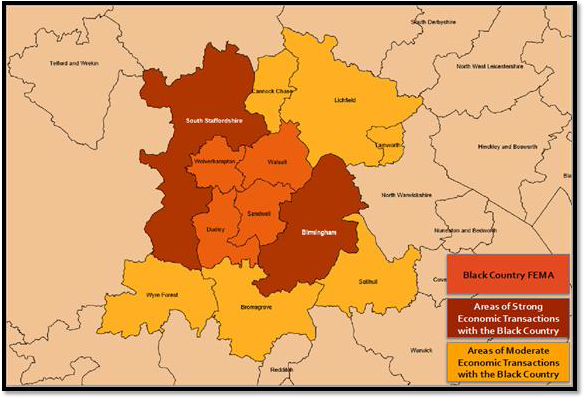
9.23Current evidence states 60.98ha or 83% of employment land need (not including replacement of employment land losses) arising in Dudley cannot be met solely within the borough[6]. This unmet need should be exported, as far as possible, to authorities that have a strong existing or potential functional economic relationship with Dudley, for example in terms of migration patterns, commuting links and / or connectivity through physical infrastructure such as rail and motorway. These are authorities evidenced as, primarily, being within the same Functional Economic Market Area (FEMA) as Dudley – the Black Country FEMA - and also those authorities outside of the FEMA, which have strong or moderate economic relationships with Dudley.
Figure 9.2 The Black Country FEMA
9.24Employment Opportunity Sites will be safeguarded for Industrial uses within Classes E(g) (ii), E(g) (iii), B2 and B8, including Manufacturing, Storage and Distribution, Warehousing and Research and Development uses. Offices are not classes as employment uses and are more appropriately located in town centres.
9.25Details of the Black Country FEMA are shown in the above Figure 9.2 The FEMA for the Black Country, as set out within the 2017 EDNA and confirmed within the 2022 EDNA update, comprises the Black Country Authorities, along with identified areas of strong economic transaction with the Black Country: South Staffs; Birmingham, and areas of moderate economic transaction with the Black Country: Wyre Forest; Bromsgrove; Solihull; Tamworth; Lichfield; Cannock Chase. Dudley’s strongest FEMA relationships with exporting LPAs outside of the Black Country, based on net migration patterns, are with Wyre Forest and Bromsgrove.
9.26The work to export unmet need is ongoing, through the Duty to Cooperate process, and evidenced through relevant Statement of Common Ground. However, given that South Staffordshire District is an area of strong economic transaction with the Black Country, and that authority has been generally able to demonstrate a surplus of employment land to meet its needs, the siting of the West Midlands (Strategic Rail Freight) Interchange (WMSRFI) near J12 of the M6 and within that district, has been the subject of an assessment by (consultants) Stantec (2021 report), to determine how much land could be exported to neighbouring authorities with strong functional economic ties with South Staffordshire.
9.27That report evidenced that 14 ha from the total 193 ha can be directly apportioned to Dudley to meet its needs. Given the robustness of this evidence that figure of 14 ha can be considered as a commitment towards contributing to Dudley’s employment land supply, which given the offer of WMSFRI as Europe’s largest new Storage and Distributions (B8) development site, can be directly attributed towards Dudley’s Storage and Distributions (B8) need total.
9.28It is recognised that as there are a limited number of vacant, brownfield sites, which are appropriately sized and located to be considered as EOS, then an emphasis needs to be placed not only on the churn of land and premises within existing employment areas to contribute towards meeting Dudley’s need, but also the renewal and rejuvenation of those employment areas so as to ensure that they become areas which can adapt to accommodate long term, sustainable economic development, particularly in providing premises for those companies involved with modern, cutting edge technologies and provide an opportunity to meet future growth needs.
9.29In order to align with and progress the objectives of the Plan aimed at the regeneration of the urban environment, a priority for the renewal of existing designated employment areas should be where such areas fall within designated Regeneration Corridors. It is also considered that suitable interventions be aimed at environmental enhancements, the incorporation of sustainable energy, drainage and transport measures, as well, where appropriate, the opening up of employment areas so that they are better integrated in with local communities which they serve: e.g., a tap house associated with a brewery.
Evidence
- Economic Development Needs Assessment (EDNA) (2023)
- Dudley Urban Capacity Review (2024)
- Black Country Employment Area Review Report (BEAR) (2021)
- West Midlands Strategic Employment Sites Study (2023)
- Strategic Employment Land Review
- Statements of Common Ground
Delivery
- Development Management Process
- Partnership with Economic Development Partners in promoting development opportunities and improvement programmes
Strategic Employment Areas
9.30This policy provides for a sufficient stock of high-quality Strategic Employment Land suitable for a growing and diversified economy.
Policy DLP19 Strategic Employment Areas
- Strategic Employment Areas are identified on the Policies Map, and are characterised by excellent accessibility, high-quality environments, and clusters of high technology growth sector businesses.
- These areas will be safeguarded for General Industrial and Storage and Distribution uses within Use Classes E(g)(ii), E(g)(iii)), B2 and B8.
- Within Strategic Employment Areas, high-quality development or redevelopment of sites and premises will be required, and proposed development that prejudices or dilutes the delivery of appropriate employment activity, or deters investment in such uses, will be refused.
- Some ancillary employment-generating non-Class E(g)(ii), E(g)(iii)), B2 and B8 uses, such as childcare facilities and small-scale food and drink outlets of less than 280 m², will be permitted in Strategic Employment Areas, where they can be shown to strongly support, maintain or enhance the business and employment function of the area and meet sequential and other national or local policy tests as necessary.
Justification
9.31Strategic Employment Areas (SEAs) are high-quality employment areas that are considered essential to the long-term success of the Dudley’s economy. They correspond to areas of the strongest occupier and market demand and are of high environmental quality with good links to the Strategic Highway Network and should be protected from non-employment uses that could impact upon their viability as employment locations. These areas contain, or have the potential to attract, those knowledge-based growth sector businesses whose success will be critical to the delivery of Dudley’s economic ambitions.
9.32Policy DLP19 is based on the approach set out in the 2011 Black Country Core Strategy, which distinguished between Strategic High-Quality Employment Areas and Local Employment Areas. The Strategic Employment Areas in the DLP are the equivalent of the (existing and potential) Strategic High-Quality Employment Areas in the Core Strategy. The EDNA recommended that the approach set out in the Core Strategy has served the Black Country well and subject to some refinement, should be carried forward into the BCA’s development plans, such as the DLP.
9.33The characteristics and extent of the Strategic Employment Areas reflect the findings of the Black Country Employment Area Review (BEAR). The BEAR re-examined the totality of the Black Country’s employment areas against a set of criteria based on those set out in the Core Strategy and the recommendations of the EDNA.
9.34 The key characteristics of Strategic Employment Areas are as follows:
- To be highly accessible to the Strategic Highway Network, preferably well located in relation to the motorway network, to provide good accessibility to international, national, and regional markets and supply chains.
- To have good public transport accessibility.
- To maintain a critical mass of active General Industrial and Storage and Distribution sites and premises that are well suited to the needs of modern industry.
- To maintain an existing (or develop a potential) high-quality nvironment, including suitable landscaping and greenspace and an attractive and functional built environment.
- To be attractive to national and / or international investment.
9.35The majority of the Strategic Employment Areas, as designated on the Policies Map, satisfy all these characteristics or are considered capable of acquiring them. The BEAR has found that it is not always necessary for an area to display all these characteristics to attract high-quality development. For example, the Pensnett Trading Estate, where the market has delivered high-quality investment, despite the area being some distance from the motorway network.
9.36The Plan seeks to safeguard land and premises within Strategic Employment Areas for industrial and Storage and Distribution activity and supports proposals that involve the improvement and renewal of land and premises within them. However, some small-scale ancillary uses will be supported in Strategic Employment Areas where this meets the day-to-day needs of employees of businesses within the Strategic Employment Areas. While Policy DLP19 considers development for uses that are not within an industrial employment use class, these will only be supported in exceptional circumstances as it is the Council’s intention to safeguard Strategic Employment Areas from non-manufacturing / logistics uses.
Evidence
- Economic Development Needs Assessment (EDNA) (2023)
- Black Country Area Review (BEAR) Report 2021
- Strategic Employment Land Review
Delivery
- Development Management Process
- Partnership with Economic Development Partners in promoting development opportunities and improvement programmes.
Local Employment Areas
9.37In order to achieve the appropriate balance and underpin the local economy, it is essential to make provision for those types of General Industrial, Storage and Distribution and commercial activities that do not need to be situated in Strategic Employment Areas and are not appropriate for town centres or residential locations.
Policy DLP20 Local Employment Areas
- Local Employment Areas are identified on the Policies Map, and are characterised by a critical mass of industrial, warehousing and service activity with good access to local markets and employees.
- These areas will be safeguarded for the following uses:
- industry and warehousing - Classes E(g)(ii), E(g)(iii)), B2 and B8.
- motor trade activities including car showrooms and vehicle repair and testing premises.
- haulage and transfer depots.
- wholesale trade and builders’ merchants.
- scrap metal, timber and construction premises.
- waste collection, transfer and recycling uses.
- Some ancillary employment-generating non-Class E(g)(ii), E(g)(iii)), and Class B2 and B8 uses, such as childcare facilities and small-scale food and drink outlets will be permitted in Local Employment Areas, where they can be shown to strongly support, maintain or enhance the business and employment function of the area, and meet sequential and other national or local policy tests as necessary.
Justification
9.38Local Employment Areas (LEAs) are particularly prevalent in Dudley, and play an important role in the local economy. They offer a valuable source of mainly low-cost industrial units that are vital in providing local jobs and a balanced portfolio of sites of different sizes and quality.
9.39Policy DLP20 is based on the approach set out in the 2011 Black Country Core Strategy, which distinguished between Strategic High-Quality Employment Areas and Local Quality Employment Areas. The LEAs in the Dudley Local Plan are the equivalent of the Local Quality Employment Areas in the Core Strategy. The EDNA recommended that the approach set out in the Core Strategy has served Dudley Borough, and the Black Country overall well and, subject to some refinement, should be continued. This has informed the policy approach of the DLP.
9.40The characteristics and extent of the LEAs reflects the findings of the BEAR. The BEAR re-examined all of Dudley’s (and the wider Black Country’s) employment areas against a set of criteria based on those in the Core Strategy and with regard to the recommendations of the EDNA.
9.41The key characteristics of LEAs are:
- a critical mass of active industrial and service uses and premises that are fit for purpose.
- good access to local markets, suppliers, and employees.
- the existing or potential use and / or the traffic generated by the use does not have an unacceptable impact on the amenity of surrounding land uses or on the highway network.
- good public transport accessibility.
9.42LEAs are designated on the Policies Map. The Plan seeks to safeguard these areas as locations for General Industrial and Storage and Distribution activity and uses that share the characteristics of Class E(g)(ii), E(g)(iii)) and B2 and B8 uses, which are typically located within industrial areas.
9.43The Plan also supports proposals that involve the improvement and renewal of land and premises within them, particularly where this involves older outdated industrial premises that are no longer fit for purpose. This process of redevelopment, intensification and enhancement of existing LEAs provides an opportunity to meet future growth needs.
9.44LEAs are often vulnerable to pressure for redevelopment to other uses such as housing. However, the loss of too much local employment land will compromise the successful delivery of the Plan’s employment strategy. It would inhibit economic development, endanger the viability of businesses, and affect the balance of jobs and workers. This would mean that workers located at companies in LEAs who are displaced by new, alternative forms of development, would have to travel increased distances to work and the viability and sustainability of firms would be put at risk. These areas will therefore be primarily safeguarded from non-employment uses.
9.45Sites within LEAs may also be appropriate for uses that serve the needs of businesses and employees working in the area. Such uses include food and drink or childcare facilities. Such uses should be of a scale, nature, and location to serve the needs of the employment area, where existing facilities are inadequate and where such needs cannot be met in adjacent centres of the Borough.
Evidence
- Economic Development Needs Assessment (EDNA) (2023)
- Black Country Area Review Report (BEAR) (2021)
- Strategic Employment Land Review
Delivery
- Development Management process
- Economic Development partners in promoting development opportunities and improvements programmes.
Other Employment Areas
9.46It is recognised that there are a number of established employment areas across Dudley Borough that are not of the quality of Strategic or Local Employment Areas. Sites and premises within these areas may be suitable for redevelopment for a continued employment use, or to alternative uses such as housing. This policy provides a flexible policy framework to guide development proposals in these areas.
Policy DLP21 Other Employment Areas
- For employment areas that are not designated as Strategic Employment Areas, Local Employment Areas or Housing Allocations on the Policies Map, but which comprise existing occupied employment land within Dudley Borough, will be classed as Other Employment Areas, and will either be:
- retained and enhanced for employment uses within Class E(g)(ii), E(g)(iii)), Class B2 and B8 and other appropriate employment uses whose impacts are consistent with those operating within the wider area, subject to site specific considerations, and allowed to be developed for such uses, or;
- be redeveloped for housing, or
- where the Other Employment Area can be evidenced as being easily and safely accessible via a direct footpath link to the boundary of a designated centre, for community, entertainment, food and drink, or leisure and recreation uses.
- Development for uses under 1(b) or 1(c) will only be acceptable where there is robust evidence to demonstrate to the satisfaction of the council, that:
- the site is no longer required or suitable for employment purposes within Clas E(g) (ii), E(g) (iii), Class B2 and Class B8 or other employment uses, including the possible relocation of displaced employment uses from other parts of Dudley Borough and
- the site is no longer viable for employment uses (evidence should be provided to show that the site has been marketed for employment uses within use class E(g) (ii), Eg (iii), B2 and B8 at a realistic market rent for a period of at least 12 months including by site notice and internet listing).
- Residential development would not prejudice or adversely affect, consistent with the agent of change principle, the existing operation and long-term investment plans of operators within Class E(g) (ii), E(g) (iii), B2 and B8 nor prejudice the redevelopment of sites to an employment use which would not adversely impact on the existing operation or other employment operations;
- the site can be brought forward for housing in a comprehensive manner and would not lead to piecemeal development.
- the site is suitable for housing or other non-ancillary non-employment uses in accordance with local or national planning policies relating to those uses.
Justification
9.47There are a number of existing employment sites and areas that are not designated as Strategic or LEA’s as, when assessed through the BEAR, they do not meet the thresholds for being allocated as LEA. These tend to be older, less marketable employment sites close to or within residential areas, where proposals for their redevelopment to deliver new homes could give rise to significant regeneration and community benefits.
9.48While employments sites within Other Employment Areas do not meet the threshold to be allocated as LEA, these areas can still play an important role in supporting the local economy. Subject to the criteria set in DLP21, some areas may be suitable for redevelopment to appropriate alternative uses such as housing. Proposed applications for such developments will be carefully considered against the need to support and protect employment uses with Dudley, due to Dudley’s acute need for employment land.
9.49It is also recognised that there are also a few such areas within the borough which, given their location within close proximity, via safe and direct pedestrian access, to an existing centre, could provide space for complementary non-employment uses to help sustain and enhance the vitality and viability of the centre.
9.50Whilst Dudley will continue to support the existing businesses within these areas, it is therefore also necessary for the Plan to allow flexibility for them to be reused for alternative forms of appropriate development. The circumstances where such redevelopment will be permitted are set out in sections 2a - f of the policy.
9.51In addressing criteria a and b, applicants will be required to submit an Economic and Market Assessment (EMA) that demonstrates that the site is unsuitable for continued employment use. The sustainability of the site’s location, including its accessibility by a choice of modes of transport, will be one matter that should be considered in this context. The EMA should also include evidence that the site is vacant (unless it can be demonstrated that occupiers are to be relocated) and has been marketed over a reasonable period of time and at realistic rental and capital values.
Evidence
- Economic Development Needs Assessment (EDNA) (2023)
- Black Country Area Review Report (BEAR) (2021)
- Strategic Employ
Delivery
- Development Management process
- Economic Development partners in promoting development opportunities and improvements programmes
Balancing Employment Land and Housing
9.52New housing and employment developments on previously developed land not allocated for these uses can make an important and positive contribution towards meeting future development needs. The following policy sets out the approach for assessing windfall employment and housing developments, ensuring they are located in suitable and sustainable locations, as well as the protection of existing business uses from non-industrial development. Such development proposals will also need to consider the Plan’s other relevant development management policies, such as DLP8 Health and Wellbeing and DLP39 Design Quality.
Policy DLP22 Balancing Employment land and Housing
- Development of housing or employment (E(g) (ii) (iii), B2 or B8 class uses) on previously developed land that is not allocated for these uses (“windfall sites”) will be permitted where the proposal accords with other Local Plan policies and subject to meeting all the following criteria:
- They are in sustainable locations that are suitable for the proposed use.
- They demonstrate a comprehensive approach, by making the best use of available land and infrastructure.
- Incremental development will only be allowed where it would not prejudice the master-planning of the wider area.
- Proposals for new development must take account of existing adjacent activities where the proposed development could have an adverse effect on or be affected by neighbouring uses, consistent with the agent of change principle. Mitigation of the impact of noise and other potential nuisances will need to be demonstrated.
Justification
9.53Locating the right development in the right place ensures that proposals are sustainable, have a positive relationship with the surrounding area and uses, and integrate well, complementing the character of their location.
9.54Policies DLP10 and DLP18 allocates sites for residential, and employment uses based on the anticipated availability of land for development at the time of the preparation of the Plan. However, there will always be windfall sites put forward for development in areas where it is not currently anticipated, and it is important that such development is brought forward in a comprehensive way.
9.55Existing businesses wanting to grow should not have unreasonable restrictions put on them because of a change in nearby land uses since they were established. Therefore, new developments will need to reflect the ‘agent of change’ principle by proving that the person or business responsible for the proposed new development / change is responsible for managing the impact of that change in relation to noise and other potential nuisances generated by existing land uses in the vicinity. Similarly, where an existing business or community facility could have a significant adverse effect on new development (including changes of use) in its vicinity, the applicant will need to provide mitigation before the development has been completed.
Evidence
- Economic Development Needs Assessment (EDNA) (2023)
- Black Country Area Review Report (BEAR) (2021)
- Strategic Employment Land Review
Delivery
- Development Management process
- Economic Development partners in promoting development opportunities and improvements programmes.
Social Value
9.56Restructuring Dudley’s economy is one of the key principles of the Dudley Local Plan’s Vision, but the provision of land and premises alone will not deliver the necessary economic transformation without new skills and training in the workforce to help it meet the challenges of changing work requirements and patterns.
Policy DLP23 Social value
- Planning applications for new major job-creating development will be required to demonstrate how job opportunities arising from the proposed development will be made available to the residents of the Dudley Borough, particularly those in the most deprived areas and priority groups.
- Planning conditions or obligations will be applied as appropriate to secure initiatives and/or contributions to a range of measures to benefit the local community, including the potential for working with local colleges and universities, to ensure the provision of:
- training and support to assist local residents in accessing employment opportunities
- improved accessibility of the development to residents by a choice of modes of transport
- child-care facilities, and
- measures to assist those with physical or mental health disabilities to access employment opportunities
Justification
9.57The Plan plays a key role in ensuring that people who suffer from social exclusion and disadvantage are able to fully contribute to the regeneration of the borough. It is therefore important that jobs created through new developments across Dudley are accessible to as many of the borough’s residents as possible, especially those in the most deprived areas or priority groups.
9.58There are several aspects to improving the accessibility of job opportunities to residents. It may be necessary for improvements to public transport infrastructure and services to be funded, and better facilities for pedestrians and cyclists to be provided. This would help ensure that residents are able to travel to and from their places of employment within reasonable timescales.
9.59Support may also need to be provided to assist residents, particularly those from either disadvantaged groups or deprived areas, in applying for new jobs and to receive training that will assist them in accessing employment opportunities. Childcare provision may also help in enhancing access to employment and individuals with mental or physical health difficulties may also require support to enable them to access jobs.
9.60There are existing support structures and facilities in place across the borough and the sub-region to help ensure that local people can access and receive appropriate training to develop the necessary skills to compete successfully for jobs.
9.61To assist with this, where major new employment-creating development is proposed, negotiations with companies will take place to devise suitable bespoke training and recruitment programmes that can benefit local people.
9.62Attracting graduates to, and retaining them within, Dudley will also be key to securing a knowledge-based economy. The higher and further education sector is a major driver of economic, social and cultural regeneration and ongoing investment in this sector is supported. Dudley Council will also support initiatives that strengthen linkages between the education sector and the wider economy.
Evidence
- Economic Development Needs Assessment (EDNA) Stage 3 (2022) and Stage 4 (2023)
- Black Country Employment Areas Review (BEAR) 2021
- West Midlands Strategic Rail Freight Interchange: Employment Issues Response Paper – Whose need will the SRFI serve? (2021)
- Site Assessment process (2023)
- Landowner Engagement Technical Report (2023)
Delivery
- Through the Development Management process
- Through partnership with Economic Development Partners in promoting development opportunities and improvement programmes
[6] The figure to be exported by Dudley and the Black Country will be further reduced by the large and small site windfall allowances identified for the Black Country overall (78ha) but this is not disaggregated to individual local authority level at this time.
