

Dudley Local Plan Part One
14. Historic Environment
Introduction
14.1The character and quality of Dudley’s historic environment is one of the borough’s greatest assets. To ensure that this is exploited to its best advantage and recognised by the community at large, it is necessary for the Dudley Local Plan to set out a positive strategy for the conservation and enjoyment of the historic environment, including the heritage assets, most at risk, and to have planning policies in place to conserve and enhance the Borough's distinctive townscape, landscape, individual buildings, monuments and archaeology identified as have a degree of significance because of their heritage interest.
14.2To underpin the historic environment policies, the Council has in-place a detailed evidence base (listed at the end of this chapter and illustrated in Figure
14.3Together they set out where physical evidence of local historic character persists to enable developers to properly assess the impact of new development upon any affected Heritage Assets and their setting in order to avoid any harm to their significance. They provide a key evidence base for this plan to inform an understanding of the historic character of the borough and its neighbouring areas and should be used by strategic planners, urban designers, intending developers and others in considering how new development proposals and the enhancement of existing townscapes and landscape should respect the local character and distinctiveness of Dudley.
14.4In combination they will assist in positive place making, the promotion of a sense of place and help to foster responsive design of buildings and surrounding spaces, helping to protect those buildings and areas which make a positive contribution to the character and distinctiveness of the borough and where relevant assist the heritage assets most at risk through neglect, decay or other threats. In this way, as is required by Government Guidance, the content of Design and Access Statements and Heritage Statements submitted in support of planning applications can be properly informed. This includes well designed, and high-quality contemporary architecture, which is sensitive to, and draws on the evidence that can both reveal, build on, and enhance the significance of the myriad of heritage assets within the Borough.
14.4Recognising this, the overarching aim of these policies is to conserve the locally distinctive character of the Borough’s historic environment as a whole, rather than focusing solely upon particularly special individual components of it. Within the wider context there are nevertheless buildings, structures, areas, and features which make important individual contributions to local character and are highly valuable in their own right. These are the nationally significant/ statutory designated heritage assets such as Conservation Areas, Listed Buildings, Registered Parks and Gardens and Scheduled Monuments.
14.5There are also many features in the borough which do not meet national criteria but are nevertheless of local historical importance and worthy of recognition. These are locally designated heritage assets otherwise known as non-designated heritage assets and include Locally Listed buildings, Areas of High Historic Townscape Value (AHHTV), Areas of High Historic Landscape Value (AHHLV), Designed Landscapes of High Historic Value (DLHHV) and Archaeology Priory Areas (APAs), (shown in figure 14.1)
Figure 14.1 Designation Framework for Heritage Assets
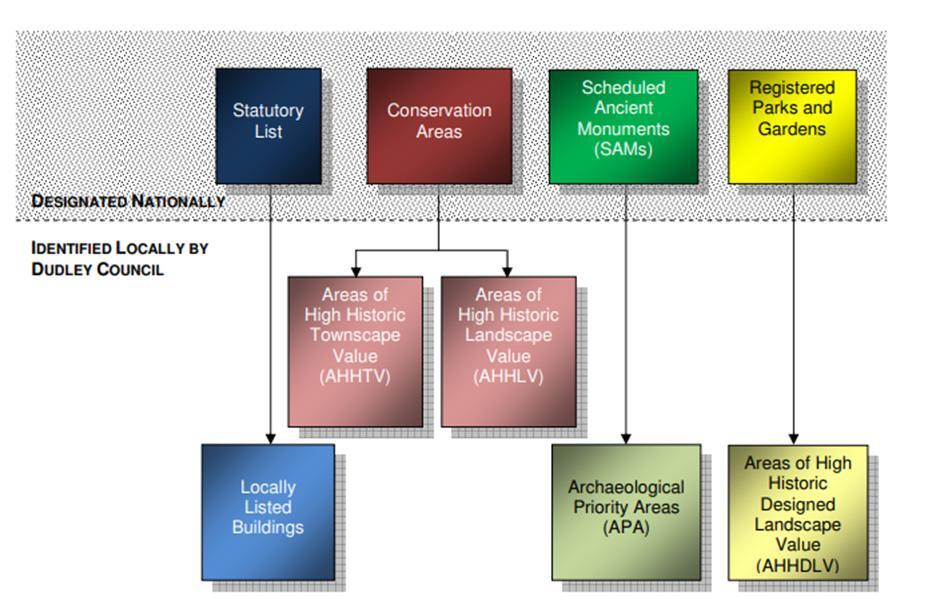
14.6An additional dimension is offered by non-designated heritage assets of archaeological interest, with structures, earthworks and buried deposits all potentially possessing further evidence that will help better reveal the understanding and significance of the Borough’s past and how it has evolved to the present. Dudley’s archaeological heritage constitutes a fundamental component of the historic environment and comprises many hundreds of buildings, sites, structures and monuments dating from the Palaeolithic to the Industrial Revolution and beyond. Together these constitute a fragile and irreplaceable resource and plan policies take full account the need for the preservation, better understanding and appropriate enhancement of the borough’s archaeological remains.
14.7Heritage Assets of the borough are recorded in detail within the Historic Environment Record (HER) held by the Council. Developers should always consult the Dudley HER at the earliest possible planning stage and before giving detailed consideration to any proposals for development which could adversely affect heritage assets of archaeological or historic significance.
14.8 As part of the Council’s approach to setting out a positive strategy for the conservation and enjoyment of the historic environment, it also identifies sites that are most at risk of being lost as a result of neglect, decay or inappropriate development. On an annual basis the Council in conjunction with Historic England prepares an annual ‘Heritage at Risk Register’. Where it finds there is evidence of deliberate neglect of, or damage to a heritage asset, appropriate action is taken, this could be use of enforcement powers and/or by not taking into account its deteriorated state as part of any decision making.
Conservation and Enhancement of the Historic Environment of Dudley
14.9Environmental enhancement and promoting sustainable development are two of the underpinning themes of the DLP, which in turn requires a co-ordinated approach to the conservation and enhancement of the built and natural environment. The protection and promotion of the historic character and local distinctiveness of the borough’s buildings, settlements and landscapes are key elements of sustainability and transformation and in particular help to protect, sustain and enhance the quality of the built and historic environment, whilst ensuring the delivery of distinctive and attractive places.
14.10 Local distinctiveness arises from the cumulative contribution made by many and varied features and factors, both special and commonplace. It is the ordinary and commonplace features of the borough that, in fact, give it its distinctiveness and help to create a unique sense of place. This is beneficial for community identity and wellbeing as well as making places attractive to investment.
14.11 Policy DLP55 aims to ensure that where physical evidence of local character persists, it should be conserved. Where development is proposed, every effort should be made to ensure that the Dudley’s historic environment is fully appreciated and enhanced in terms of its townscape, landscape and individual heritage assets, and that new development makes a positive contribution to the local character and distinctiveness of the borough.
Policy DLP54 Conservation and Enhancement of the Historic Environment of Dudley
- All relevant development proposals within Dudley should sustain and enhance the historic locally distinctive character of the area in which they are to be sited, whether formally recognised as a designated heritage asset or as a non-designated heritage asset. They should respect and respond to its positive attributes in order to help maintain Dudley’s strong sense of place, including its listed buildings, conservation areas and undesignated heritage assets.
- Where a proposal would affect a heritage asset the applicant will be required to have undertaken an assessment proportionate to the significance of the asset and having clear regard to appropriate evidence thereafter to provide a sufficiently justified description of:
- The significance of the asset including any contribution made by its setting and impacts of the proposal on this significance and
- The justification for the proposal, how it seeks to preserve or enhance the asset/setting or where this is not possible, how it seeks to minimise the harm.
- Where a proposed development will lead to substantial harm to (or total loss of significance of) a designated heritage asset, permission will be refused unless it can be demonstrated that the substantial harm or total loss is necessary to achieve substantial public benefits that outweigh that harm or loss, or all of the following apply:
- the nature of the heritage asset prevents all reasonable uses of the site; and
- no viable use of the heritage asset itself can be found in the medium term through appropriate marketing that will enable its conservation; and
- conservation by grant-funding or some form of not for profit, charitable or public ownership is demonstrably not possible; and
- the harm or loss is outweighed by the benefit of bringing the site back into use.
- Where a development proposal will lead to less than substantial harm to the significance of a designated heritage asset, this harm will be weighed against the public benefits of the proposal including, where appropriate, securing its optimum viable use.
- The effect of an application on the significance of a non-designated heritage asset should be taken into account in determining the application. In weighing applications that directly or indirectly affect non-designated heritage assets, a balanced judgement will be required having regard to the scale of any harm or loss and the significance of the heritage asset.
- In considering proposals affecting both designated and non-designated heritage assets, including those of archaeological interest of demonstrably equivalent significance to a scheduled monument, involving their alteration, extension, demolition, change of use and/or development in their setting, the Council will include in their consideration as appropriate:
- The asset’s archaeological, architectural, artistic and historic interest and any contribution to its significance from setting (including the wider historic landscape)
- scale, form, layout, density, design, quality and type of materials, and architectural detailing
- boundary treatments and means of enclosure
- implications of associated car parking, services and other environmental factors
e. effect on streetscape, roofscape and skyline including important views within, into or out of heritage assets
f. impact on open space which contributes positively to the character and/or appearance of heritage assets
g. the positive benefits of the proposal in addressing heritage at risk.
- Where heritage assets are included on a Local List and are affected by development proposals the Council will afford weight proportionate to their heritage significance in the decision-making process to protect and conserve the significance which underpins their inclusion. Partial or total loss adversely impacting this significance will require clear and convincing justification.
8. The effect of proposals on the significance of non-designated heritage assets will be taken into account in determining applications for development. Applications which result in harm or loss of significance to non-designated heritage assets will only be supported if clear and convincing justification has been demonstrated. In making a decision, the Council will weigh the significance of the heritage asset affected against the scale of any harm or loss to it.
9. Where applications are permitted which will result in (total or partial) loss to a heritage asset’s significance (including where preservation in situ of buried archaeological remains is not necessary or feasible), applicants will be required to arrange for further assessment of and recording of this significance in advance of, and where required, during development/works
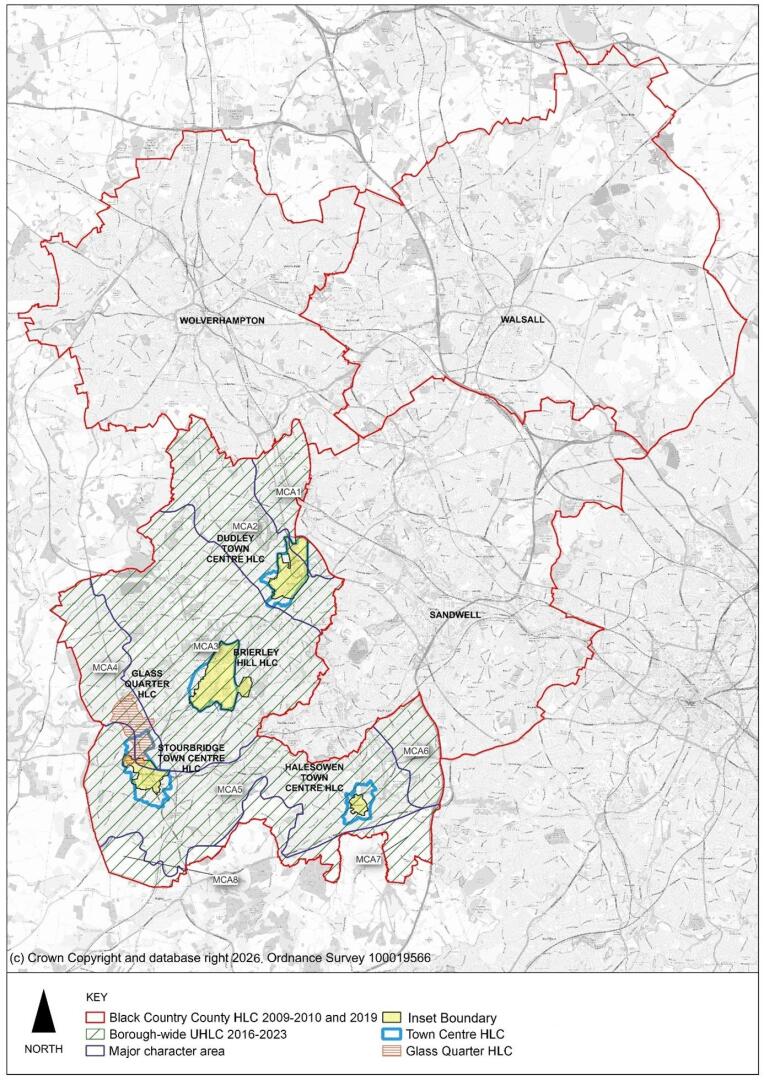
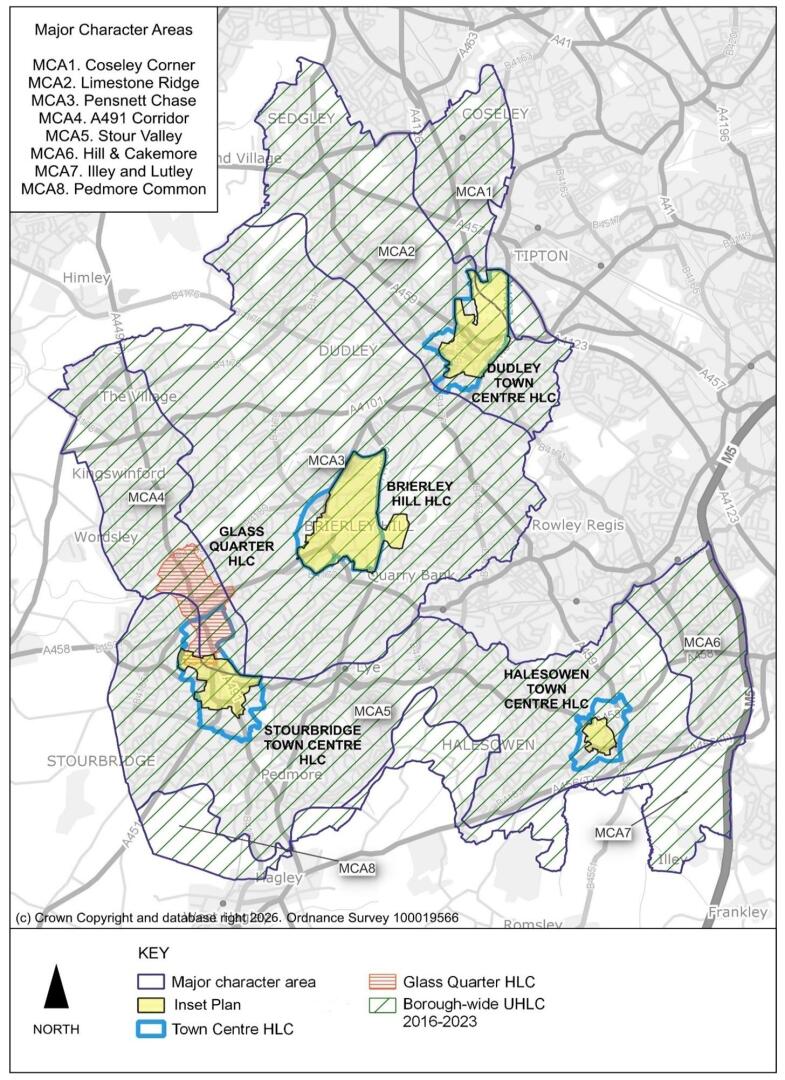
14.12Dudley has a rich and diverse historic environment, which is evident in the survival of individual heritage assets and in the local character and distinctiveness of the broader landscape. The geodiversity of the borough and the wider Black Country underpins much of the subsequent development of the area, the importance of which is acknowledged by the inclusion of the Black Country Geopark in the UNESCO Global Geopark Network. The exploitation of abundant natural mineral resources, particularly those of the South Staffordshire coalfield, together with the early development of the canal network, gave rise to rapid industrialisation and the distinctive settlement patterns that characterise the area.
14.13Towns and villages with medieval origins survive throughout the area and remain distinct in character from the later 19th century industrial settlements, which typify the coalfield and gave rise to the description of the wider Black Country area as an “endless village” of communities, each boasting a particular manufacturing skill for which many were internationally renowned.
14.14Beyond its industrial heartland, the character of the borough can be quite different and varied. The green borderland, most prominent in parts of the south of the borough, is a largely rural landscape containing fragile remnants of the ancient past. Undeveloped ridges of high ground punctuate the urban landscape providing important views and points of reference that define the character of the many communities. Other parts of the borough are characterised by attractive, tree lined suburbs with large houses in substantial gardens and extensive mid-20th century housing estates designed with modern principles.
14.15The Borough contains a rich mix of locally distinctive areas. This includes:
- The network of now coalesced but nevertheless distinct small industrial settlements of the former South Staffordshire Coalfield, such as Netherton.
- The civic, religious, and commercial cores of the principal settlements of medieval origin such as Dudley and Halesowen;
- Surviving pre-industrial settlement centres of medieval origin such as Kingswinford.
- Rural landscapes and settlements including villages / hamlets of medieval origin, relic medieval and post-medieval landscape features (hedgerows, holloways, banks, ditches, field systems, ridge and furrow), post-medieval farmsteads and associated outbuildings, medieval and early post-medieval industry (mills etc.) and medieval and post-medieval woodland. The undeveloped nature of these areas means there is also the potential for evidence of much earlier activity that has largely been lost in the urban areas.
- Areas of Victorian and Edwardian higher-density development, which survive with a high degree of integrity including terraced housing and its associated amenities.
- Areas of extensive lower density suburban development of the mid-20th century including public housing and private developments of semi-detached and detached housing.
- Public open spaces, including Victorian and Edwardian municipal parks, often created from earlier large rural estates or upon land retaining elements of relict industrial landscape features.
- The canal network and its associated infrastructure, surviving canal-side pre-1939 buildings and structures together with archaeological evidence of the development of canal-side industries and former canal routes (see Policy DLP36).
- Buildings, structures and archaeological remains of the traditional manufacturing and extractive industries of Dudley and the wider Black Country including glass making, metal trades, brick-making, coal mining and limestone quarrying.
- Geosites of geological, historic, cultural, and archaeological significance within the UNESCO Black Country Geopark (see Policy DLP35).
- The Beacons and other largely undeveloped high prominences lying along the Sedgley to Northfield Ridge (including Sedgley Beacon and Wrens Nest), Castle Hill and views to and from these locations.
- New and incremental developments all have a role in sustaining and enhancing them.
14.16To ensure that heritage assets make a positive contribution towards the wider economic, social and environmental regeneration of the borough, it is important that they are not considered in isolation but are conserved and enhanced within their wider context. A holistic approach to the built and natural environment maximises opportunities to improve the overall image and quality of life in Dudley by ensuring that historic context informs planning decisions and provides opportunities to link with other environmental infrastructure initiatives.
14.17An analysis and understanding of the local character and distinctiveness of the area has been made using historic landscape characterization (HLC) principles. Using this approach, the designated heritage assets (i.e Registered Parks and Gardens, Scheduled Monuments, Conservation Areas and Listed buildings) have been considered along with non-designated heritage assets, resulting in a number of Locally distinctive areas of the borough being designated (i.e Designed Landscapes of High Historic Value, Archaeology Priority Areas, Areas of High Historic Townscape Value, Areas of High Historic Landscape Value, and a ‘local list’ of buildings or structures of local historic importance.
14.18In order that the degree of impact of a development proposal can be fully assessed it is essential that the significance of heritage assets including their setting, is fully understood. A Heritage Assessment is therefore required for any development proposals which is likely to affect the significance of a heritage asset, including its setting. Where necessary, the Heritage Assessment should include a qualitative visual assessment to show how the proposal affects the heritage significance of its surroundings. Further information on the types of assessment and level of detail required can be found in the Council’s Historic Environment Supplementary Planning Document (SPD).
Registered Parks and Gardens (RPG’s) and Designed Landscapes of High Historic Value (DLHHV)
14.19Some areas of the borough retain landscape features that are the product of a formal design process with the intention of producing both a functional and aesthetically pleasing landscape. Such areas include Parks, gardens and cemeteries.
Registered Parks and Gardens – designated heritage asset
14.20 Nationally a Register of Parks and Gardens of Special Historic Interest is maintained by Historic England to recognise the contribution to national heritage of the finest designed landscapes. Within the borough, there are two Registered Parks and Gardens:
- The Leasowes – Grade 1 Registered Park and Garden of Special Historic Interest. A "ferme ornee" landscape laid out in 1740s and 1750s by William Shenstone which was a potent influence on the style of landscape gardening then and in the later 18th Century.
- Priory Park – Grade II Registered Park and Garden of Special Historic Interest. An early 20th Century public park developed as part of a town planning scheme by Edward Prentice Mawson from an existing early and mid-19th Century villa garden on the site of a medieval priory.
14.21 The Council will resist any development or other works taking place which would harm the significance or be detrimental to the setting, character, quality and historic integrity of Registered Parks and Gardens of Special Historic Interest.
14.22 The Registered Parks and Gardens at the Leasowes and Priory Park will be preserved and enhanced in order to protect and maintain their unique features and their significance.
Designed Landscapes of High Historic Value (DLHHV) – non-designated heritage assets
14.23 The borough-wide Historic Landscape Characterisation Survey (HLCS) and Black Country HLCS recognises that there are numerous other formally designed landscaped areas within Dudley Borough that make an important contribution to its character as a result of their design and historic associations which would not meet the criteria for inclusion on this national register. To ensure that the contribution of these areas to local character and distinctiveness is fully recognised in planning for the future of Dudley Borough, the most historically significant of these have been identified as Designed Landscapes of High Historic Value (DLHHV).
14.24 Relevant new development should consider the impact the development would have on the significance on areas of DLHHV
Scheduled Monuments, Heritage Assets of Archaeological Interest, and Archaeological Priority Areas (APA’s)
14.25 Dudley’s Historic Environment Record (HER) register’s numerous Heritage Assets of archaeological interest (as defined by the NPPF Annex 2). In addition, there is also a much smaller number of Heritage Assets of archaeological interest that are already positively identified as important at the national level, and which have been formally designated as Scheduled Monuments (SMs) (designated heritage assets) and these are subject to strict controls under national legislation. The NPPF advises that other currently non-designated assets of archaeological interest that are demonstrably of equivalent significance to scheduled monuments should also be considered.
14.26 In this context there are sites and areas throughout Dudley Borough recorded in Dudley Council’s HER that have not yet been formally designated as a Scheduled Monument but have been identified through the Borough-wide Historic Characterisation Survey, and also in the HLC documents prepared for Brierley Hill, Dudley, Halesowen Stourbridge and the Glass Quarter and in the Black Country Historic Landscape Characterisation Study (2019), as having a high potential for the survival of archaeological remains of regional or national importance. These are considered to be “Archaeological Priority Areas” (APA) (non-designated heritage assets) and have been previously identified and designated by the Council.
14.27 The Council will need to consider the preservation of Heritage Assets of archaeological interest when assessing applications for new development proportionate to its designation. However, where a development proposal affects a Scheduled Monument or an Archaeological Priority Area, developers may require a full physical evaluation following desktop archaeological appraisal proportionate to the level of significance.
14.28 The Council considers it reasonable that throughout the Borough, adequate information as to the nature, quality and conditions of archaeological remains affected by development proposals should be provided by the applicant in order that the local planning authority may assess the archaeological impact of the proposals and identify requirements for archaeological preservation.
14.29 Archaeological remains of interest should be preserved in situ and landowners may be required to enter into management agreements in this regard. Where this would be unreasonable, to ensure that provision is made for an appropriate level of archaeological investigation and recording of any buildings structure or buried deposit of interest prior to the commencement of development or, in some cases, prior to the determination of a planning application
14.30 Where a development proposal is deemed to have a damaging impact upon significant archaeological remains, and where potentially negative impacts have been identified, developments may be required to carry out an agreed schedule of suitable measures designed to mitigate such impact in order to preserve buildings, structures or buried deposits in situ.
14.31 Archaeological Priority Areas (APA’s) define areas of the borough as having high potential for the survival of archaeological remains of regional or national importance.
Buildings or structures of Local Historic and/or Architectural Importance
14.32 Many buildings and structures in the borough which do not currently meet national criteria for statutory listing are nevertheless of significant local historical importance and worthy of protection and conservation in their own right. The Council has adopted a Local List of such buildings, based on the contribution they make to the character and distinctiveness of the borough’s townscape and landscape.
14.33The majority of Dudley’s historic buildings and structures, including industrial archaeological remains, were built after 1840 and so will often not meet the national criteria necessary for inclusion on the statutory lists. This does not, however, diminish their importance in terms of the local historic character of the many different townships which make up Dudley Borough. The ‘Local List’ and Policy DLP58 aims to ensure there is a measure of protection for these locally significant buildings/structures.
14.34 The Council will resist development which will involve:
- inappropriate demolition or part demolition of buildings or structures on the Local List
- inappropriate alteration or extension to buildings or structures on the Local List and
- have a detrimental impact on the setting or context of buildings or structures on the Local List including development which conflicts with the intrinsic historic value of the building and its setting and the local character of the wider area.
14.35 Proposals for the change of use of a building or structure on the Local List should demonstrate how they contribute to its conservation whilst preserving or enhancing its architectural or historic interest and conserving and enhancing its significance.
14.36Applications proposing demolition should demonstrate that the viability of continued beneficial use restoration or conversion has been fully investigated and that there are no reasonable alternatives and in cases where demolition is unavoidable provision should made for an appropriate level of archaeological buildings recording to take place prior to demolition by suitably qualified persons and the results added to the Historic Environment Record (HER).
Conservation Areas
14.37Conservation Areas are designated heritage assets and are areas that have been designated because of having special architectural or historic interest, the character or appearance of which it is desirable to preserve or enhance. There are currently 22 designated Conservation Areas within the borough, and their boundaries are to be found on the Proposals Map. In addition to the information provided in the Historic Environment SPD, the borough-wide Historic Landscape Characterisation Study and in the various HLC documents, information about the borough’s Conservation Areas can also be found in the relevant Conservation Area Appraisals.
Policy DLP55 Conservation Areas
- The Council will seek to preserve or enhance the character or appearance of the Conservation Areas. Proposals which enhance or better reveal the significance of the conservation area will be encouraged. Proposals for the demolition, alteration or extension of buildings in Conservation Areas; or proposals for works which would be detrimental to their character, appearance or setting; and proposals which could prejudice views into or out of Conservation Areas will be resisted.
- The Council will require the use of building materials appropriate to the Conservation Area in all new development. Any new development or alterations should respect the historical or vernacular building character, proportion, massing and relationship between buildings and the spaces between them and with their setting.
Justification
14.38 Policy DLP56 aims to ensure that special attention is paid to desirability of preserving or enhancing the character or appearance of the conservation areas of the borough.
14.39 Where planning permission is granted for the demolition of structures of historic interest in Conservation Areas, the Council will seek to ensure that provision is made for an appropriate level of archaeological buildings recording to take place prior to demolition and the results added to the Historic Environment Record (HER).
14.40 To prevent gap sites, consent for demolition will, where appropriate, be subject to a condition providing that demolition shall not take place until a contract for carrying out redevelopment works is in place and planning permission for those works has been granted in line with the requirements of legislation, the NPPF and the Dudley Local Plan.
14.41 The Council will continue to undertake a review of Conservation Areas throughout the borough and where appropriate will amend or create new Conservation Areas in accordance with guidance provided by Historic England.
Listed Buildings
14.42 Listed Buildings are those included in a statutory list compiled by the Secretary of State after having been recognised as being of particular special architectural or historic interest. There are approaching 300 such designated heritage assets in the borough. As well as being special in themselves, Listed Buildings often make a great contribution to the character of a wider locality. Their retention and sensitive conservation are accordingly key concerns.
14.43 Listed Building Consent must be obtained from the Council for demolition or any alteration, extension which would affect its significance. This requirement relates equally to internal and external alterations. Applicants for consent must be able to justify their proposals and will need to demonstrate why proposed works affecting the building’s special interest are necessary.
14.44 Details of Listed Buildings within the borough can be found on the Council’s website and on Heritage Gateway[48].
Policy DLP56 Listed Buildings
- Proposals for demolition, inappropriate alteration of or addition to statutorily Listed Buildings, or for development which would harm their significance or be detrimental to their setting, will be resisted. Where Listed Building Consent is granted for demolition or alteration resulting in the loss of historic fabric, the Council will ensure that provision is made for an appropriate level of archaeological buildings recording to take place prior to the commencement of the approved works by appropriate and suitably qualified persons.
Justification
14.45Policy DLP57 aims to ensure that special regard is made to the desirability of preserving the listed building or its setting or any features of special architectural or historic interest which possesses.
14.46The Council will protect, conserve and encourage the appropriate enhancement of buildings statutorily listed as being of historic or architectural value.
14.47Applicants proposing the alteration, extension or change of use of a statutorily Listed Building should provide proportionate information to demonstrate how the proposals would contribute to the building’s conservation, whilst preserving or enhancing its architectural or historic interest.
14.48Where such proposals would affect a listed structure which has a particularly complex building history and would involve a major impact on the historic plan form or significant loss of historic fabric, applicants may be required to commission a professional archaeological predetermination heritage impact assessment. This should include an appropriate level of archaeological buildings recording, an analysis sufficient to demonstrate the significance of the existing plan form and historic fabric to be affected, be to an agreed timescale and clarify the degree of impact which the proposals would have upon the building’s historic character and appearance.
Areas of High Historic Townscape Value (AHHTV)
14.49 The Council has identified and designated Areas of High Historic Townscape Value (AHHTV) in the borough-wide HLCS 2016 and also in the HLC documents prepared for Brierley Hill, Dudley, Halesowen Stourbridge and the Glass Quarter and in the Black Country Historic Landscape Characterisation Study. AHHTV’s are non-designated heritage assets that highlight the existence of certain areas of the borough that exhibit a concentration of heritage assets and other historic features that, in combination, make a particularly positive contribution to local character and distinctiveness. These areas are thereby considered to be “Areas of High Historic Townscape Value”.
Policy DLP57 Areas of High Historic Townscape Value (AHHTV)
- New development proposals affecting an AHHTV, as defined by Dudley's Historic Landscape Characterisation Survey (HLCS), should response to the existing positive characteristics of the locality, including the public realm, in order to create complementary good quality design.
Justification
14.50Areas of High Historic Townscape Value (AHHTV) define areas of townscape of acknowledged importance and Policy DLP59 aims to ensure that where new development is proposed in an AHHTV, every effort must be made to ensure it consolidates or enhances its existing positive characteristics and that views into, out of and within the AHHTV are respected.
14.51 Heritage Statements and Design and Access Statements accompanying planning applications in AHHTV’s should be prepared drawing on the borough-wide Historic Landscape Characterisation Study (HLCS) to produce a locally responsive, high-quality design that, wherever appropriate, conserves and enhances significant heritage assets together with their settings.
Areas of High Historic Landscape Value (AHHLV)
14.52 The Council has identified in the Borough-wide HLCS 2016 and also in the HLC documents prepared for Brierley Hill, Dudley, Halesowen Stourbridge and the Glass Quarter and in the Black Country Historic Landscape Characterisation Study (2019) Areas of High Historic Landscape Value.
14.53 AHHLV’s are non-designated heritage assets that recognise the importance of the wider landscape elements of the historic environment such as areas of open space, woodland, watercourses, hedgerows and archaeological features and their contribution to local character and distinctiveness as well as their historic, communal, ecological and aesthetic values.
Policy DLP58 Areas of High Historic Landscape Value (AHHLV)
- Within Areas of High Historic Landscape Value, the Council will resist development which would have a materially detrimental impact upon the character, quality and historic integrity of the landscape.
2. The Council will seek to protect and enhance views into, from or within Areas of High Historic Landscape Value.
Justification
14.54 Policy DLP60 aims to ensure that where new development is proposed in an AHHLV, every effort must be made to ensure it consolidates or enhances its existing positive characteristics and that views into, out of and within the AHHLV are respected.
14.55 Heritage Statements and Design and Access Statements accompanying planning applications in or adjacent to an AHHLV, should be prepared drawing on the Borough-wide Historic Landscape Characterisation Study (HLCS). The Design and Access Statement should clearly evidence in a proportionate manner how the proposal has taken account of the HLCS in order to produce a locally responsive high-quality design that, wherever appropriate, conserves and enhances significant landscape heritage assets together with their settings.
Registered Parks and Gardens (RPG’s) and Designed Landscapes of High Historic Value (DLHHV)
14.55 Some areas of the borough retain landscape features that are the product of a formal design process with the intention of producing both a functional and aesthetically pleasing landscape. Such areas include Parks, gardens and cemeteries.
Evidence
- Black Country Historic Landscape Characterisation (2010)
- Black Country Historic Landscape Characterisation Study (2019)
- Borough-Wide Urban Historic Landscape Characterisation Study (2016/2023)
- Historic Environment Supplementary Planning Document (2017)
- Historic Landscape Characterisation for Brierley Hill, Dudley, Halesowen, Stourbridge and the Glass Quarter.
- Historic Environment Record (HER)
- National Design Guide
- Historic England Good Practice Advice Notes (GPAs) and Historic England Advice Notes (HEANs)
Delivery
- Historic Landscape Characterisation documents
- Adopted Conservation Area Character Appraisals
- Development Management process including Design and Access Statements and Statements of Heritage Significance
- Supplementary Planning Documents
- A regularly updated and maintained Historic Environment Record (HER).
[48] Heritage Gateway. Available from: https://www.heritagegateway.org.uk/gateway/default.aspx
