

Dudley Local Plan Part One
7. Health and Wellbeing
Introduction
7.1The purpose of the planning system in England is to contribute to the achievement of sustainable development. The built and natural environments are key determinants of health and wellbeing. The NPPF states that one of the three overarching objectives of the planning system is supporting strong, vibrant, and healthy communities. The Health and Social Care Act (2012) gave local authorities new duties and responsibilities for health improvement and requires every local authority to use all levers at its disposal to improve health and wellbeing; Local Plans are one such lever.
7.2Planning policies and decisions should aim to make sufficient provision for facilities such as health infrastructure, sport and physical activity infrastructure and aim to achieve healthy, inclusive, and safe places that support healthy lifestyles, especially where they address identified local health and wellbeing needs. Engagement between Dudley and relevant organisations helps ensure that local the Dudley Local Plan supports these aims.
7.3Ensuring a healthy and safe environment that contributes to people’s health and wellbeing is a key objective of Dudley Council and their partners in the health, voluntary and other related sectors.
Linkages between health and the built and natural environment
7.4The linkages between health and the built and natural environment are long established and the role of the environment in shaping the social, economic and environmental circumstances that determine health is increasingly recognised and understood. Climate change will have a negative impact on health and wellbeing and action to eliminate emissions and adapt to climate change, such as promoting active travel and improving the energy efficiency of buildings, will also benefit public health through outcomes such as reduced obesity and fuel poverty.
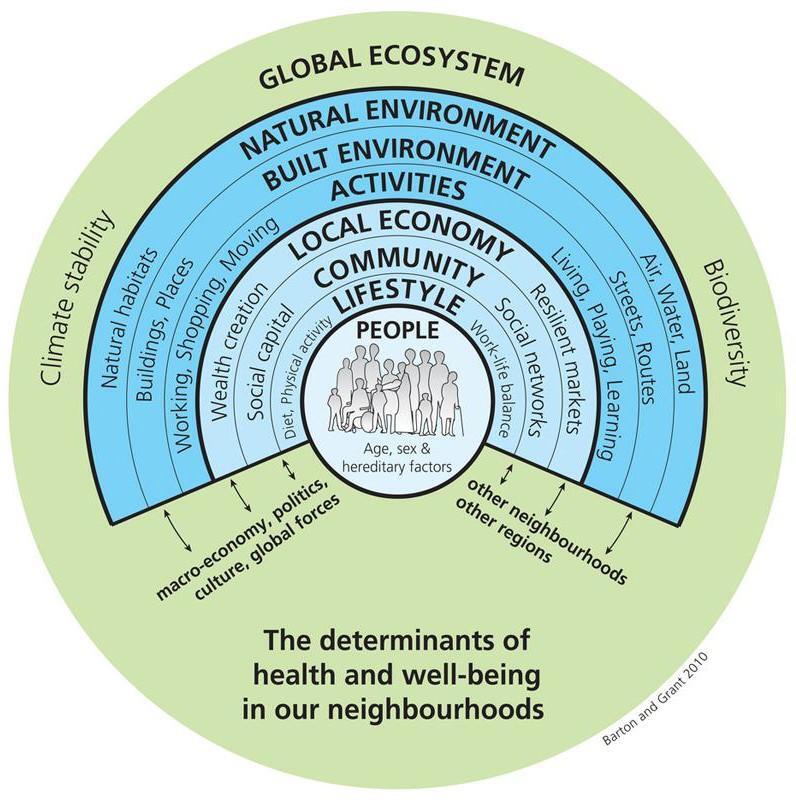
7.5An increasing body of research indicates that the environment in which people live is linked to health across their lifetime. For example, the design of neighbourhoods can influence physical activity levels, travel patterns, social connectivity, food consumption, mental and physical health, and wellbeing outcomes. These are illustrated in the Barton and Grant (2010) Health Map.
Figure 7.1 The determinants of health and wellbeing in our neighbourhoods
7.6Evidence including from the Sustainability and Transformation Partnership suggests that the Black Country, including Dudley, performs worse than the average for England with regards to risk factors for poor health outcomes that are linked to the built and natural environment. For example, Dudley has lower rates of physical activity and higher rates of obesity. Poor air quality is harmful to health and unhealthy fast food is easily available. In the home, rates of falls and hip fractures in older people are high, as are households living in fuel poverty, meaning people are exposed to the risk of cold housing in winter thereby exacerbating long-term conditions.
7.7Dudley has lower rates of both life expectancy and healthy life expectancy than the average for England meaning people not only die earlier but live more of their life with ill health, which has implications for their ability to be productive and for how they use the built and natural environment. Dudley also has higher rates of multiple deprivation, of children living in poverty and of unemployment than the rest of England. These factors all contribute to poorer health outcomes and are influenced by the built and natural environment.
7.8Dudley also has higher rates of hospital admissions for alcohol compared to the England average. Many users of adult social care say they feel isolated and experience poor health-related quality of life.
7.9The Dudley Health and wellbeing Strategy 2023-28, identifies the following as goals for tackling health and wellbeing:
- Children are ready for school
- Fewer people die from circulatory disease
- More women ae screened for breast cancer
7.10Therefore, there is a need for the DLP to support initiatives aimed at encouraging healthier lifestyle choices, mental wellbeing and addressing socio-economic and environmental issues that contribute to poor health inequalities.
Policy DLP8 Health and Wellbeing
- The Council will support developments which create an environment that promotes healthy communities, protects, and improves the physical, social and mental health and wellbeing of its residents, including children, young people and vulnerable adults and which reduces health inequalities. Developments should help to maximise opportunities to improve the quality of life, make it easier for people within Dudley to lead healthy, active lifestyles and encourage healthy choices.
- Developments which have a significant negative impact on health and wellbeing will not be supported where applicants cannot provide mitigation of, or compensation for such impacts through planning conditions and/or financial/other contributions secured through planning obligations.
- Dudley will support vibrant centres and local facilities which contribute to the physical, social, and mental wellbeing of its residents. This will include managing the locations, concentration or and operation (including opening hours) of the following uses:
- Proposed developments for Hot food takeaways (including hybrid uses incorporating such uses). Developments will only be supported where they support this aim and Policy DLP29
- Betting shops and amusement arcades
- The following developments are required to provide a Health Impact Assessment as part of the planning application[3]:
- Residential developments over 150 dwellings or 5ha
- Industrial developments over 5ha
- Other developments over 1ha
- New developments which include any of the following uses:
- Hot Food Takeaways
- Betting Shops and Amusements Arcades
- Developments which would result in the loss of any of the following uses:
- Education facilities
- Health facilities
- Leisure and Community facilities
- Publicly accessible open space
Justification
7.11The DLP encourages planning decisions that help improve the overall health and wellbeing of residents and help people lead healthier lives more easily. The aim of the policy is to assess and improve the health impacts of new developments and minimise negative impacts. Improving the health of residents helps to reduce the burden on the National Health Service, thereby providing society with wider economic benefits.
7.12A Health Impact Assessment can be a useful tool in assessing development proposals where there are expected to be significant impacts on health and wellbeing. They should be used to reduce adverse impacts and maximise positive impacts on the health and wellbeing of the population, as well as reduce health inequalities, through influencing the wider determinants of health. This may include provision of infrastructure for health services or for physical activity, recreation, and active travel. Health Impact Assessments help to achieve sustainable development by finding ways to create a healthy society and enhance and improve the places where people live.
7.13Health Impact Assessments can be carried out at any stage in the development process but are best undertaken at the earliest stage possible. This should ideally be prior to the submission of planning applications, to ensure that health and wellbeing issues are considered and addressed fully at the outset. Where this is not appropriate, they should form part of the material submitted to support the relevant planning application. This can be provided as a standalone assessment, or as part of a wider Sustainability Appraisal (SA), Environmenta Impact Assessment (EIA), or Integrated Impact Assessment (IIA).
7.14The Marmot Review (February 2010) highlighted that socio-economic inequalities, including the built environment, have a clear effect on the health outcomes of the population. One of the key policy objectives aimed at reducing the gap in life expectancy between people of lower and higher socio-economic backgrounds, is to ‘create and develop healthy and sustainable places and communities’.
7.15In February 2020, The Institute of Health Equity published the Health Foundation’s Health Equity in England: The Marmot Review 10 Years On. The report highlights that poor health is increasing, the health gap has grown between wealthy and deprived areas and that place matters to health. The review went on to recommend:
- Investment in the development of economic, social and cultural resources in the most deprived communities
- 100% of new housing to be carbon neutral by 2030, with an increased proportion being either affordable or in the social housing sector
- Aim for net zero carbon emissions by 2030 ensuring inequalities do not widen as a result.
7.16Many of these issues as well as other issues which impact on the health and wellbeing on the residents of Dudley Borough are also addressed in the wider policies of the Dudley Local Plan, such as the provision of active travel, affordable housing and tackling climate change.
7.17Residents of Dudley Borough suffer from poorer health outcomes, particularly in the more deprived wards, than the rest of England, across a broad range of indicators. The evidence from Public Health England and elsewhere suggests that Dudley also performs worse with regards to risk factors for poor health outcomes that are linked to the built environment.
7.18Dudley has higher rates of physically inactive adults and children and higher rates of obesity than those for England as well as lower rates of the population eating ‘five a day’ and a higher number of fast-food outlets per 100,000 population. Obesity is considered a risk factor for cancer and diabetes and maternal obesity is a risk factor for infant mortality and associated with poor health. High concentrations of Hot Food Takeaways in certain areas of those which are not appropriately located, can result in an undue influence on poor choice of diet than contributes to a wider range of health issues discussed above. Additionally, such proposals can lead to increased levels of environmental health issues, such as odour, litter issues and anti-social behaviour).
7.19Gambling is becoming an increasing risk to the mental and physical health of residents and is viewed as a public health issue. Studies have shown that people with gambling disorders have an increased risk of dying from any cause as well as links to mental health disorders such as anxiety and depression. Within the West Midlands participation in gambling activities are higher than the average in England. Research has shown gambling establishments are targeted in areas of higher deprivation. Within Dudley Borough, this is demonstrated in Dudley Town Centre, which is within the 10% most deprived neighbourhoods in the country, where there is a high prevalence of gambling establishments within the High Street. There are concerns about the accessibility and prevalence of gambling establishments on the health and wellbeing of residents.
Evidence
- Dudley Health and Wellbeing Strategy, 2023-28, Dudley Health and Wellbeing Board
- Black Country Integrated Care Board, Primary Care Estates Strategy.
- Black Country Integrated Care Board, Primary Care Estates Strategy, Dudley Estates Pack.
- Black Country ICB, Integrated Care Strategy.
- A Healthy Map for the Local Human Habitat – Strategic Review of Health Inequalities in England post-2010, Institute of Health Equity, 2010.
- Fair Society, Healthy Lives: The marmot Review – Strategic Review of Health Inequalities in England post-2010, Institute of Health Equity, 2010
- Health Equity in England: the Marmot Review 10 years on, Institute of Health Equity, 2020
- Planning for Health in the Black Country: Evidence Base for Black Country Plan Health and Wellbeing Chapter, 2021
- Health Impact Assessment in spatial planning, a guide for local authority public health and planning teams, Public Health England, October 2020
- Active Design, Sports England, May 2023
- Healthy High Streets Assessments, Dudley Public Health, 2024
Delivery
- Through Development Management and Supplementary Planning Documents
- Implementation and funding will be sought through planning conditions, planning agreements and planning obligations as well as through external funding sources.
Healthcare Infrastructure
Policy DLP9 Healthcare Infrastructure
- New Healthcare facilities should be:
- Well-designed and complement and enhance neighbourhood services and amenities;
- Well-served by public transport infrastructure, walking and cycling facilities and directed to a centre appropriate in role and scale to the proposed development, and its intended catchment area, in accordance with policies DLP24 and DLP25. Proposals located outside centres must be justified in terms of relevant policies such as DLP26 and DLP27, where applicable;
- Wherever possible, located to address accessibility gaps in terms of the standards set out in Policy DLP11, particularly where a significant amount of new housing is proposed;
- Where possible, co-located with a mix of compatible community services on a single site.
- Existing primary and secondary healthcare infrastructure and services will be protected unless it can be demonstrated that:
- The loss of the existing facility has a satisfactory replacement, or,
- Where healthcare facilities are declared surplus or identified as part of an estates strategy or service transformations plan where investment is needed towards modern, fit for purpose infrastructure and facilities, there will be no requirement to retain any part of the site in a healthcare use.
- New or improved healthcare facilities and services will be provided, in accordance with requirements agreed between the Local Planning Authority and Local Health Organisations.
- Proposals for major residential developments of 10 units or more must be assessed against the capacity of existing healthcare facilities and/or services. Where the demand generated by the residents of the new developments would have unacceptable impacts upon the capacity of these facilities, developers will be required to contribute to the provision or improvement of such services. Where is it not possible to address such provision through planning conditions, a planning agreement or planning obligations may be required.
- In the first instance, infrastructure contributions will be sought to deal with relevant issues on the site or in its immediate vicinity. Where this is not possible, an offsite (commuted sum) contribution will be negotiated.
- The effects of the obligations on the financial viability of development will be a relevant consideration. Where necessary, financial viability assessments will be required to be submitted.
Justification
7.20Meeting Dudley’s future housing needs will have an impact on existing healthcare infrastructure and generate demand for both extended and new facilities across the Plan area, as well as impacting upon service delivery as population growth results in additional medical interventions in the population.
7.21Health Services in Dudley are currently experiencing limitations on their physical and operations capacity, which inhibit their ability to respond to the area’s health needs.
7.22Dudley Council and its partners, including other healthcare infrastructure providers, have a critical role to play in delivering high-quality services and ensuring Dudley Borough’s healthcare infrastructure amenities and facilities are maintained, improved and expanded[4].
7.23As the borough grows and changes, social and community facilities must be developed to meet the changing needs of the borough’s diverse communities. This will in turn mean that, new, improved and expanded healthcare facilities will be required. It is proposed to support and work with the NHS and other health organisations to ensure the development of health facilities where needed in new development areas. Opportunities will be explored for the co-location of health and other community facilities such as community centres, libraries and sport and recreation facilities.
7.24Funding for many healthcare infrastructure projects will be delivered from mainstream NHS sources, but for some types of infrastructure, an element of this funding may also include contributions from developers. This may relate to the provision of physical infrastructure, such as premises, or social infrastructure, such as the delivery of additional services. These contributions would be secured through planning agreements or planning obligations, in line with the relevant regulations in operation at the time; these are currently the Community Infrastructure Levy (CIL) Regulations 2010 (as amended). As set out in the latest national guidance and any local guidance, contributions will be sought initially to support infrastructure on-site, with alternatives being considered where this is not possible.
7.25In establishing the needs for and level of any developer contributions, residential developments will be assessed against the ability of nearby primary healthcare provision to be delivered without being compromised by demand from additional residents. Assessment of the capacity of existing healthcare facilities to meet the demand generated by residents of new development, uses an established method adopted by the Integrated Care Board (ICB). Applicants should consult the ICB in advance of the submission of a planning application where a significant amount of housing is to be provided. It is proposed to produce separate guidance as part of an SPD, on the methodology used for calculating the appropriate level of developer contributions.
7.26As part of viability considerations, depending on the extent of other planning obligations required, such contributions may not be viable on some sites, where it can be proved that it is not viable for a housing developer to fund all its own healthcare needs, alternative funding sources will be sought.
Evidence
- Black Country Integrated Care Board, Primary Care Estates Strategy
- Black Country Integrated Care Board, Primary Care Estates Strategy, Dudley Estates Pack
- Black Country ICB, Integrated Care Strategy.
- The Black Country STP Draft Estates Strategy, Black Country and West Birmingham Sustainability and Transformation Partnership, July 2018.
- Summer 2019 STP.ICS Estates Strategy Check-point Return, Black Country and West Birmingham Sustainability Transformation Partnership, July 2019
- Health Infrastructure Strategy, Dudley Clinical Commissioning Group, May 2016
- Planning for Health in the Black Country: Evidence Base for the Black Country Plan Health and Wellbeing Chapter, 2021.
[3] Health Impact Assessments (HIA) should be a level of detail appropriate to the scale and nature of the proposed development. An initial screening HIA should be undertaken irrespective of whether a full HIA is required.
[4] The infrastructure strategies of these partner organisations have helped inform this policy
