

Dudley Local Plan Part One
17. Waste Management
Introduction
17.1This section sets out the needs for waste infrastructure to support growth in the borough, in accordance with National Planning Policy for Waste (NPPW). The key driver is to minimise the amount of waste generated across all sectors and increase the re-use, recycling, and recovery rates of waste material (seeking to achieve net self-sufficiency). The Council will work collaboratively with other Waste Planning Authorities to address the identified waste infrastructure needs.
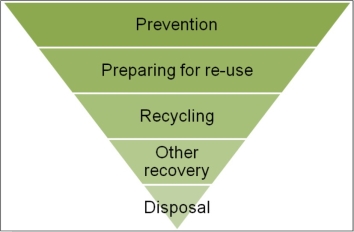
17.2This policy sets out the overall strategy and principles for waste management and the types of waste development that will support this. It also identifies how much new waste management capacity is likely to be needed to support planned levels of growth over the plan period. The approach is in line with the NPPW and its principle of driving waste management up the waste hierarchy (as set out in the diagram below).
Figure 17.1 The Waste Hierarchy
17.3 The Local Plan policies are focused on the borough’s waste requirements and infrastructure, however given the nature of waste management (where waste arising in one area is often managed in another, and facilities will have catchment areas that extend beyond their boundaries) the wider context of the Black Country area (and beyond) is recognised.
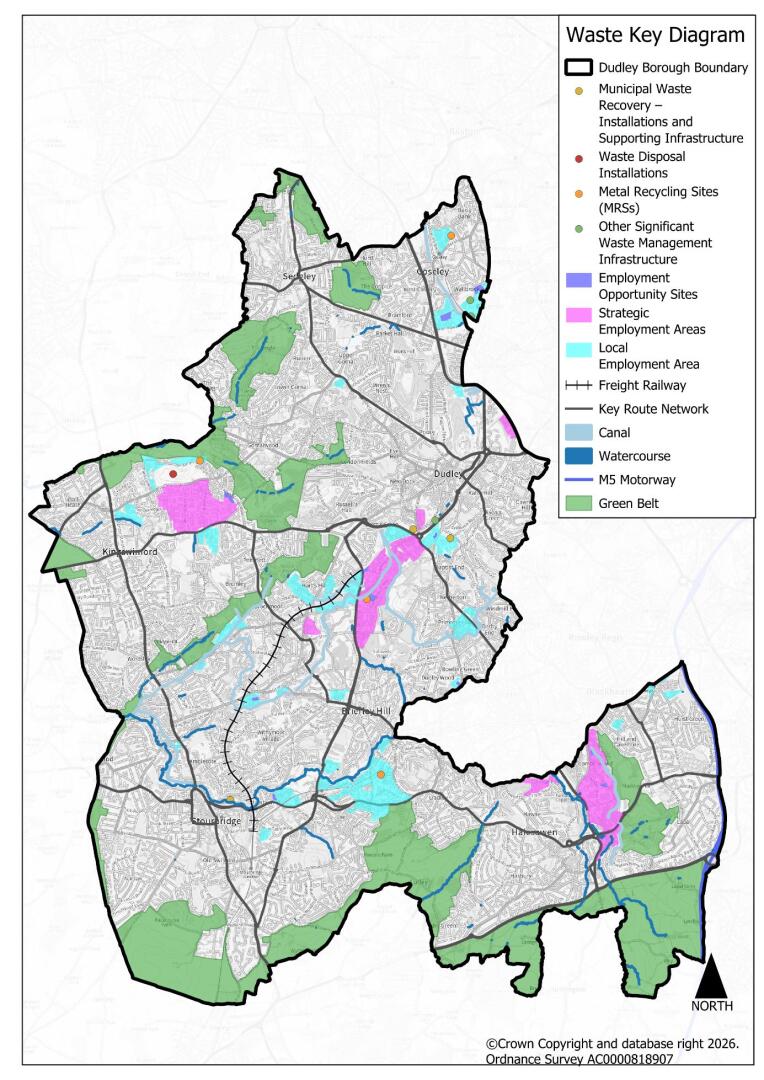
Figure 17.2 Spatial Strategy Plan: Waste
Policy DLP70 Waste Infrastructure - Future Requirements
- Development proposals should demonstrate how they will minimise waste production, as well as facilitating the re-use and recovery of waste materials including, for example, through recycling, composting and energy from waste (see Policy DLP73 and Policy DLP42).
- The Council will work collaboratively with other waste planning authorities to ensure a co-operative cross-boundary approach to waste management. The Council will support an increase in the borough’s waste management capacity via individual development proposals upon the following principles:
- managing waste through the waste hierarchy in sequential order and at the highest point of the waste hierarchy as possible. Sites for the disposal of waste will only be permitted where it meets a need which cannot be met by treatment higher in the waste hierarchy.
- ensuring that sufficient capacity is located within the borough to accommodate the waste capacity requirements during the plan period (as far as practically possible) as identified below to maintain net self-sufficiency and reducing the reliance on other authority areas.
Waste management capacity requirements (2021 – 2041)
|
Tonnes |
|
|---|---|
|
Re-use / recycling |
400,000 – 473,000 |
|
Energy Recovery |
143,000 – 152,000 |
|
Disposal |
129,000 – 192,000 |
- enabling the development of recycling facilities across the borough, including civic amenity sites, and ensuring that there is enough capacity and access for the deposit of municipal
Justification
17.4In line with national waste planning guidance, the Plan aims to make provision for the suitable management of waste. Housing and employment land are projected to increase in the borough as the regeneration of the urban area progresses, to help meet strategic housing and employment targets.
17.5 In seeking to identify development sites for waste infrastructure, priority shall be given to the safeguarding of existing sites for their continued use and the retention of the local employment areas in which they occur (see Policy DLP71 and Policy DLP20). As waste facilities are an essential part of the infrastructure of an area, it is not only important that they are appropriately located, but also that policy protection is applied to areas suitable for waste uses, to help achieve the objectives of moving waste up the hierarchy.
17.6 Waste reduction and resource efficiency improvements will have a significant influence on future waste growth. The transition towards a circular economy, the approach to economic development designed to benefit businesses, society and the environment, is expected to significantly change the way waste will be managed in future. In particular, the quantities of waste reused, recycled, and composted are expected to increase substantially.
17.7 Transitioning towards the circular economy will involve a significant reduction in the amount of waste produced by households and businesses, because avoidable waste will be ‘designed out’ of products at the manufacturing stage. It will also mean a significant shift away from methods of managing unavoidable waste at the bottom of the ‘waste hierarchy’ (waste disposal and energy recovery) and towards those at the top of the hierarchy which can ‘close the loop’ (re-use and recycling). A circular economy and the effective management of waste also has a role to play in helping to address climate change, e.g., the re-use of resources helps reduce the demand for new materials and the emissions associated with producing the latter.
Updated Baseline for Dudley
17.8 The Dudley Borough Waste Study (2023) provides an updated baseline on waste arisings, imports and exports. In 2021 Dudley was estimated to generate approximately 470,000 tonnes of waste. Excluding exempt sites, the largest waste stream was estimated to be construction, demolition and excavation (CD&E) waste at over 254,000 tonnes. Just under 127,000 tonnes were collected by the Council from household sources. Commercial and industrial (C&I) waste arisings (including LACW non-household sources) were estimated to be just under 70,000 tonnes and hazardous waste arisings to be over 19,000 tonnes. Other waste stream arisings were just over 400 tonnes, composed primarily of agricultural waste.
17.9 With the exception of exempt sites, over 114,000 tonnes (23.5%) were re-used, recycled or composted, over 182,000 tonnes (37.6%) were subject to recovery or treatment, over 149,000 tonnes (37.6%) (mainly construction and demolition waste) was disposed to landfill, and just over 40,000 tonnes (8.3%) were transferred for management elsewhere.
17.10 Dudley is an importer of waste with facilities within its boundaries (including permitted sites and incinerators) managing 662,000 tonnes in 2021. Of this total the biggest percentage (by tonnage) (24%) was received at Treatment sites, followed by Landfill sites (24%), Metal Recycling Sites (23%), Incinerators (15%) with the remainder managed through Transfer sites (14%).
17.11 Overall, Dudley was estimated to import circa 1,500 tonnes more waste than it exported in 2021, with the vast majority of these imports (85%) arising from within the West Midlands Region. Dudley was a net importer of hazardous waste by approximately 2,000 tonnes and a net exporter of non-hazardous waste by a mere 360 tonnes.
17.12 Despite being a net importer, exports from Dudley amounted to nearly 450,000 tonnes in 2021. Of the 450,000 tonnes of waste received at permitted sites in England and Wales and incinerators in England, outside of Dudley, the biggest percentage (by tonnage) (29%) was received at Landfill sites, followed by Treatment sites (22.5%), Metal Recycling Sites (18.5%), Incinerators (16%), Transfer (10%) and On/In Land sites (4%).
Projected Future Waste Capacity Requirements
17.13 The updated waste capacity requirements are based upon the housing and employment growth figures for the borough as set out in the DLP. Under the projections, the quantity of waste Dudley is projected to manage (included imported waste) increases from 1.2 million tonnes (mt) in 2021 to 1.5 mt in 2040/41 equating to an increase of 32% or 1.4% per annum (see Table 17.1 below). An ongoing emphasis on waste reduction has seen a 14% reduction in waste per household since 2006/07 and this trend could have a significant influence on future waste growth. However, there are emerging changes in the need for different types of waste management capacity. Exports already reflect a shortage of landfill space; household waste material processing plants and composting facilities and the way waste will be manged in the future is expected to change significantly with transition towards a Circular Economy. In particular, the quantities of waste reused, recycled and composted are expected to increase substantially.
Table 17.1 Projected Waste Growth over the Plan period by Waste Stream (tonnes)
|
Waste Stream |
2021/22 |
2025/26 |
2030/31 |
2035/36 |
2040/41 |
|---|---|---|---|---|---|
|
Imports |
682,000 |
696,000 |
714,000 |
732,000 |
750,000 |
|
Household |
127,000 |
130,000 |
133,000 |
136,000 |
140,000 |
|
Commercial and Industrial |
70,000 |
72,000 |
75,000 |
78,000 |
81,000 |
|
Construction, Demolition and Excavation |
254,000 |
285,000 |
339,000 |
404,000 |
481,000 |
|
Agricultural |
300 |
300 |
400 |
400 |
400 |
|
Hazardous |
19,000 |
19,000 |
20,000 |
20,000 |
21,000 |
|
TOTAL |
1,153,000 |
1,202,000 |
1,281,000 |
1,371,000 |
1,473,000 |
Waste Management Scenarios & Capacity Gaps
17.14 Three waste management scenarios are presented according to the extent to which the Circular Economy targets for re-use and recycling of C&I and municipal waste over the plan period 2021/22 to 2040/41 are met. Based on the assumption that the ‘Circular Economy’ recycling targets will either be met (WMS2) or partially met (WMS3), the Dudley Borough Waste Study, 2023 (at Table 3.9) predicts that the following additional waste management capacity will need to be delivered up to 2041 to maintain the Borough’s net self-sufficiency:
Table 17.2 Waste management capacity requirements (2021-2041)
|
WMS2 (tonnes) |
WMS3 (tonnes) |
|
|---|---|---|
|
Re-use/Recycling |
473,000 |
400,000 |
|
Energy Recovery |
143,000 |
152,000 |
|
Disposal |
129,000 |
192,000 |
17.15 This takes account of known future developments or closures of waste management facilities. Total waste management capacity is projected to decrease from 758,000 tonnes in 2021 to 718,000 tonnes in 2041 which is driven by decreasing landfill space with recycling, recovery and transfer capacity not anticipated to change significantly.
17.16Most of the new capacity requirements identified are expected to be delivered by the waste industry rather than by the Council as the Waste Planning Authority. Delivery will therefore depend on whether new projects are financially viable and attractive to investors. This will in turn depend on demand from waste producers, the effectiveness of government initiatives to incentivise re-use and recycling of waste in preference to energy recovery and disposal to landfill, and the availability of suitable sites within the borough where the new facilities can be built. The Council is looking to provide an additional Household Waste Recycling Centre (HWRC) to the north or centre of the borough to complement its existing Stourbridge HWRC, and a search for a suitable site remains ongoing.
17.17 The Dudley Borough Waste Study identifies that more than 80% of waste imported and exported from Dudley stays within the West Midlands region. Waste flows within the West Midlands emphasises the interdependence that exists between the authorities within this region. It is recognised that ongoing cooperation and collaboration with relevant local authorities will be required to ensure waste capacity requirements that cannot be delivered within the borough are available in other areas, where there are existing import/export relationships established and ongoing (e.g., disposal at landfills).
Evidence
- Dudley Borough Waste Study (2023), WSP
Delivery
- Waste Industry and Investors – develop new waste management infrastructure in locations that are well placed to meet demand from waste producers, supported by investors.
- Dudley Council – deliver new/ upgraded WTS/ HWRC/ MRF capacity needed to support separate collection of waste glass, metal, paper, card and food from households and increased recycling of these wastes. Determine planning applications for new waste infrastructure and upgrading or expansion of existing waste infrastructure within the prescribed/ agreed target dates.
Waste Sites
17.18 This policy seeks to safeguard and retain the capacity of existing lawful waste facilities to maintain the existing waste management capacity.
Policy DLP71 Waste Sites
Protecting Waste Sites
- The Council will safeguard all existing strategic and other lawful waste management facilities[52] from inappropriate development to maintain and increase existing levels of waste management capacity, consistent with the waste hierarchy, unless it can be demonstrated that:
- This policy will also apply to all new waste management sites that are implemented within the lifetime of the plan.
New development near existing waste facilities
- Proposals for housing and other potentially sensitive uses will not be permitted near to55 or adjacent to an existing waste management site where there is potential for conflict between the uses that cannot be fully mitigated (applying the ‘agent of change’ principle) unless a temporary permission for a waste use has expired, or the waste management use has otherwise ceased. Waste Site Impact Assessments must be submitted as supporting information to such proposals and these should demonstrate that any conflicts arising will be fully mitigated.
Justification
17.19 The focus of the Plan is on safeguarding strategic waste sites, while also giving appropriate protection to other waste sites[56]. Given their importance to the borough’s waste management capacity, there will be a stronger presumption against the loss of strategic waste sites.
17.20 The existing strategic sites are identified on the Waste Diagram and listed in Table 17.2 below are the significant waste management facilities operating in the borough. They have been identified through a detailed analysis of all known licenced and exempt facilities and include waste treatment, waste transfer, waste to energy and landfill facilities.
17.21The definition of a strategic waste management site is;
- all facilities that form a vital part of the borough’s municipal waste management infrastructure, e.g. energy from waste plants, waste transfer facilities and HWRCs, depots.
- all commercial waste management facilities that fulfil more than one local role, e.g. they are part of a nationwide or regional operation linked to other facilities elsewhere and take in waste from all over the borough and / or beyond.
- all commercial facilities specialising in a particular waste stream or waste management technology, of which there are no others, or very few other of the same type operating elsewhere in the borough.
- a site with sufficient capacity to recover, treat or dispose of at least 20,000 tonnes of waste per annum.
- all facilities likely to make a significant contribution towards existing waste management capacity (see points c and d).
- a facility for waste disposal, such as landfill sites.
- a hazardous waste recovery facility of sufficient size to qualify as a Nationally Significant Infrastructure Project (NSIP).
|
Local Plan Ref. |
Previous Local Plan Ref (2011 Black Country Core Strategy) |
Site Name and Address |
Estimated Operational capacity (tonnes per annum, tpa) |
|---|---|---|---|
|
Municipal Waste Recovery Installations |
|||
|
WS1 |
WSD6 |
Dudley Energy from Waste facility, Lister Road Depot, Lister Road, Dudley |
95,000 |
|
Municipal Waste Recovery-supporting Infrastructure |
|||
|
WS2 |
WSD11 |
Blowers Green Recycling Depot, Blowers Green Road, Dudley |
40,000 |
|
WS3 |
n/a |
Lister Road Transfer Station, Lister Road Depot, Lister Road, Dudley |
23,500 |
|
WS4 |
WSD10 |
Stourbridge Household Waste Recycling Centre (HWRC) off Birmingham Street (A458), Stourbridge |
20,000 |
|
Waste Disposal Installations |
|||
|
WS5 |
WSD5 |
Himley Quarry Landfill, Oak Lane, Kingswinford |
220,000* |
| Significant Metal Recycling Sites (MRS) | |||
|
WS6 |
WSD9 |
Shakespeare’s MRS, Oak Lane, Kingswinford |
40,000 |
|
WS7 |
WSD1 |
Sims MRS Halesowen, James Scott Road, Cradley, Halesowen (formerly E Coley Street) |
35,000 |
|
WS8 |
n/a |
Wades of Wednesbury, Webb Street, Coseley |
20,000 |
|
WS9 |
n/a |
Woodside Works, Blackbrook Road, Dudley (Dartmouth Global Trading) |
35,000 |
| Other Significant Waste Management Infrastructure | |||
|
WS10 |
n/a |
AB Waste Management and Skip Hire (formerly Bloomfield Recycling), Coseley |
45,000 |
|
WS11 |
n/a |
Budden Road Waste Transfer Station, Coseley |
25,000 |
|
WS12 |
n/a |
Environmental Contracts Ltd (ECL) Waste Transfer, Dudley |
25,000 |
Safeguarding Existing and Planned Waste Sites
17.22 The need for new housing and employment development must be balanced against the need to retain the infrastructure needed to support local households, businesses, and the construction industry. This includes the infrastructure that manages the waste they generate. Waste Planning authorities must therefore ensure that the impact of non-waste development on existing and planned waste facilities is acceptable, and “does not prejudice the implementation of the waste hierarchy and/ or the efficient operation of such facilities” (NPPW).
17.23 The Plan therefore recommends a safeguarding policy for existing strategic and other waste sites (Policy DLP71). However, the policy also recognises that the redevelopment of existing or former waste management sites with new housing, employment or other land uses is sometimes justified. For example, redevelopment is likely to be acceptable where the waste facility has already closed, or the operator is proposing to close it or relocate the operations to another site.
17.24 Another important material consideration will be whether or not the waste operations are lawful, i.e., whether they have planning permission or a lawful development certificate.
17.25 Given their importance to the borough’s waste management capacity, there will be a stronger presumption against the loss of strategic waste sites and against developments which would prejudice their continued operation. The policy will also apply to all new waste management sites that are implemented.
Potential Impacts Upon Existing Waste Management Capacity
17.26 When determining applications for non-waste development within a short distance or adjacent an existing waste management facility, regard will be had to any potential adverse impacts the proposed development might have on the future of the site as a location for the continuation of waste management activities. If a development is likely to have an unacceptable impact on the future of the site as a location for waste management, it will be refused. The ‘agent of change’ principle set out in national planning policy will be applicable i.e., existing businesses and facilities should not have unreasonable restrictions placed on them as a result of development permitted after they were established; the ‘agent of change’ (the new development) should provide suitable mitigation before the development has been completed.
Waste Site Impact Assessments
17.27 Taking on board the Black Country Waste Study recommendations, the policy requires applications for non-waste development, which could be sensitive to the operation of a waste management site, on or near to an existing or planned waste site to include a Waste Site Impact Assessment. This should:
- identify the waste site potentially affected;
- explain the spatial relationship between the application site and the waste site;
- provide a brief description of the waste site, which should include:
- its operational status and any proposed changes;
- the facility type;
- whether the site is a strategic waste site;
- the types of waste managed;
- the waste operations permitted on the site.
- summarise the main effects of the waste operations;
- identify any effects that could be harmful to the health, wellbeing, and amenity of the occupiers of the new development;
- assess how the occupiers of the new development could be affected;
- assess how the waste site could be affected by the development;
- demonstrate how the development complies with the policy and the measures proposed to ensure that the waste site and the proposed development can coexist without compromising each other. This includes proposals for any mitigation measures required, including environmental controls such as screening which can provide a more permanent and effective solution.
Evidence
- Black Country Waste Study (2020), Wood
- Dudley Borough Waste Study (2023), WSP
- Black Country Council’s Water Cycle Study: Phase 1 (2020) and Dudley Stage 2 Water Cycle Study (2024), JBA Associates
Delivery
- Planning applications and permissions
- Waste Industry- engage positively with developers and the local planning authority on proposals to change the use of existing or planned waste sites and proposals for non-waste development near to existing or planned waste sites
- Developers- ensure that new development near to existing or planned waste sites have regard to the potential effects on both developments, ensure that proposals for non-waste development make efficient use of resources and are designed to include sufficient space for secure waste storage, management and collection.
Locational Considerations for New Waste Facilities
17.28 Steering waste management facilities towards the most suitable locations where they are likely to generate maximum benefits in terms of co-location, provide supporting infrastructure for other uses and minimise potential harmful effects on the environment and local communities will support the strategic objectives of the Plan.
Policy DLP72 Locational Considerations for New Waste Facilities
Key Locational Considerations for All Waste Management Proposals
- Proposals should evidence how they will contribute to the strategic objectives of Policy DLP70, such as the contribution they will make towards delivery of new waste management capacity, diversification of the range of facilities currently available and the management of waste in accordance with the waste hierarchy.
- Development for new build waste management facilities should be focused in local employment areas (primarily Local Employment Areas- Policy DLP20 but also retained other employment areas, where appropriate). Proposals for all new waste management facilities will be required to meet the following criteria:
- All waste processes and operations must be contained, processed and managed within buildings unless there are acceptable operational reasons why these processes cannot be contained in buildings.
- Minimise and mitigate any identified harm to water quality and resources and flood risk management and impacts upon the drainage network.
- Demonstrate the appropriateness of the site in respect of land instability matters.
- Minimise and mitigate adverse landscape and visual impacts.
- Minimise and mitigate adverse effects on the natural and historic environment and public health.
- Minimise and mitigate adverse impacts on the highway and transport network, avoiding the generation of excessive traffic.
- Minimise and manage the generation of noise, vibration, odours, litter, light, dust, and infestation.
- Land use conflict- proposals should demonstrate compatibility with the uses already present within / adjacent to the area (applying the ‘agent of change’ principle).
- Where necessary mitigation measures should be identified to reduce any adverse effects under criteria 2b-2h to an acceptable level.
Waste Applications – Supporting Information
- Planning applications for waste development (Note 1 below) must include a supporting statement that clearly describes the key characteristics of the development. It should also explain how the development aligns with the principles and preferred methods of managing waste in Policy DLP70. In particular, the application should explain the contribution the development would make towards driving waste up the waste hierarchy, supporting the development of a more circular economy, meeting the boroughs’ additional waste capacity requirements, and broadening the range of waste facilities currently available in the plan area.
Notes: (1) This includes applications for new build waste developments, changes of use to waste developments, applications for new operational development and other material changes to existing waste sites, and ‘s73’ applications to vary a condition attached to an existing waste permission.
Justification
17.29 National policy requires the Council to identify suitable sites and areas for waste management in the Plan. This Policy DLP72 identifies that in principle Local Employment Areas and other employment areas may be appropriate locations for new waste facilities.
17.30Many of the waste management facilities have operations that are similar to industrial processes and therefore may also be located in other retained employment areas. Operators seeking a location for new waste management facilities should be focusing their search on areas to be retained as employment land and should avoid those areas proposed to change to housing.
17.31While most types of waste facilities are likely to be acceptable in all Local Employment Areas (Policy DLP20), the list of facilities acceptable on Strategic Employment Areas (Policy DLP19) is much shorter. They will normally be restricted to fully enclosed operations that fall within Use Classes E(g)(iii) or B2 and are already classified as employment uses, or sui generis operations that would be compatible with a Strategic Employment Area location and would not compromise existing or potential future employment uses falling within Use Classes E(g)(ii), E(g)(iii), B2 or B8 (Policies DLP19 and DLP20). Policy DLP72 reflects this approach.
17.32 Certain waste operations may be acceptable on ‘Other Employment’ land (Policy DLP21) not identified as Strategic or Local Employment Areas for long-term retention in employment land use. This will depend on the site-specific circumstances.
17.33 There are certain types of waste management facilities that require an open site and will therefore be difficult to accommodate within the urban areas of the borough due to the lack of suitable sites (e.g., open window composting facilities). These types of facility are subject to strict regulation by the Environment Agency and must be located at least 250m away from sensitive receptors.
17.34 The policy sets out the criteria against which new waste management proposals will be assessed. There are a number of other issues common to all waste developments that should be addressed in all cases. For example, the relationship of the proposal to the strategy for waste and resources as set out in Policy DLP70 is of paramount importance, and all applications should explain how the proposed development is aligned with these principles. They should also address other locational issues such a proximity to the source of waste, relationships to adjoining / neighbouring uses, visual impacts and other potential effects on the surrounding area. Potentially harmful environmental / amenity impacts will be minimised where operations are contained within a building or enclosure, so facilities should always be enclosed where feasible.
Waste Applications – Supporting Information
17.35 All waste applications should be accompanied by a supporting statement which provides a general description of the development.
17.36 Applicants will be required to provide a certain amount of information about their proposed development on the planning application form, including information about the waste streams to be managed and the maximum annual throughput in tonnes and/ or void space in cubic metres. However, as the space available on the form is limited, a more comprehensive description of the proposed waste operations should be provided in the supporting statement.
17.37 The supporting information to be provided is set out below. This should enable the Council to understand the types of operation proposed and the potential effects of the development. The most appropriate place to set out in detail and assess such a proposal against relevant planning policies is within a Planning Statement. In addition, if the development is ‘EIA development’ (meaning it requires an Environmental Impact Assessment), as Schedule 1 or 2 development, details should be included in an Environmental Statement (ES)[57].
17.38 The following information should be included in the supporting statement and/or on the planning application form:
- the type of waste facility or facilities proposed.
- the waste streams and types of waste to be managed.
- the types of operation to be carried out on the site. d. whether waste would be sourced locally, regionally or nationally.
- the maximum operational throughput in tonnes per annum.
- for waste disposal, the total void space to be infilled in cubic metres.
- the outputs from the operations, including waste residues.
- the expected fate and destination of the outputs.
- the number of associated vehicular movements.
- where relevant, plans for detailed restoration and aftercare schemes.
Evidence
- Black Country Waste Study (2020), Wood
- Dudley Borough Waste Study (2023), WSP
- Black Country Employment Area Review (BEAR) (2021), Black Country Local Authorities
- Authority Monitoring Report
Delivery
- Planning applications and permissions
- Engagement with relevant stakeholders as part of pre-application and planning application process, including waste operators, Environment Agency, Environmental Health.
Resource Management and New Development
17.39Managing material resources – including waste - in a responsible way is an important element of sustainable development and will support the strategic objectives of the Plan.
Policy DLP73 Resource Management and New Development
- All new developments should;
- address waste as a resource.
- minimise waste as far as possible.
- design sites to cater effectively for resource and waste management.
- manage unavoidable waste in a sustainable and responsible manner.
- maximise use of materials with low environmental impacts.
- Where a proposal includes uses likely to generate significant amounts of waste (e.g. above that normally expected or for large commercial uses) these should be managed either on-site or in as close a proximity as possible to the source of the waste.
- Resource and waste management requirements should be reflected in the design and layout of new development schemes. Wherever possible building, engineering and landscaping projects should use alternatives to primary aggregates, such as secondary and recycled materials, renewable and locally sourced products and materials with low environmental impacts. Consideration should also be given to how waste will be managed within the development once it is in use.
- Where redevelopment of existing buildings or structures and / or remediation of derelict land is proposed, construction, demolition and excavation wastes (CD&EW) should be managed on-site where feasible and as much material as possible should be recovered and re-used for engineering or building either on-site or elsewhere.
Justification
17.40This policy sets out general principles on waste and resource efficiency to be addressed by new developments, including requirements to manage large amounts of waste on site or nearby, recycle and re-use products as far as possible.
17.41Achieving zero waste growth and driving waste up the “waste hierarchy” are important objectives of national policy guidance and the strategy for waste management in the borough. Delivering on site-waste management of waste and making better use of waste generated through development will contribute to the delivery of these objectives.
17.42This policy sets out the minimum requirements for planning applications for all developments to demonstrate how they have addressed waste and resource issues. Major development schemes should provide evidence of how they are addressing these issues within the supporting information such as the Design and Access Statement, a Planning Statement, a Site Waste Management Plan, or any equivalent document.
17.43Residential developments should include adequate storage for recyclable and nonrecyclable waste pending collection, including storage for recyclable wastes and access for waste collection vehicles.
17.44The resources and waste management requirements of businesses will be an important consideration in development projects to improve employment areas, town, and district centres. Where feasible, regeneration schemes should include provision for on-site waste management.
17.45 Where organisations are generating significant amounts of a particular type of waste, which is not currently managed in the borough, consideration should be given towards waste being disposed of or being recovered at the nearest appropriate facility(s).
17.46 Opportunities for symbiosis – matching waste producers with organisations who might have a use for the waste produced - should be explored.
Evidence
- Black Country Waste Study (2020), Wood
- Dudley Borough Waste Study (2023), WSP
- Authority Monitoring Report
Delivery
- Planning applications and permissions
- Developers- ensure that proposals for non-waste development make efficient use of resources and are designed to include sufficient space for secure waste storage, management and collection.
- Waste Collection Authority- provide advice to developers on the waste bins and storage space required in residential developments.
[52] Subject of an extant permanent or temporary planning permission.
[53] In appropriate locations elsewhere in the borough in the first instance, where possible, or locations outside the borough.
[54] In appropriate locations elsewhere in the borough in the first instance, where possible, or locations outside the borough.
[55] The definition of ‘near’ in terms of specific distances is likely to vary according to the nature of the individual waste site. The Black Country Waste Study (2020) suggests 100-150metres should be applied for more significant uses with tighter boundaries around smaller facilities.
[56] This takes forward the approach under the former Black Country Local Plan Review whereby strategic waste sites accounted for nearly 75% of the Black Country’s estimated operational waste management capacity by tonnage.
[57] Or any equivalent following the Government’s review of the Environmental Impact Assessment regulations.
