

Dudley Local Plan Part Two
7. Local Green Space
Local Green Space Designations
7.1A Local Green Space designation is a way to provide special protection for green areas of particular importance to local communities. The Council has designated an area of green space for special protection, as outlined in the policy table below. The Local Green Space has been put forward by the local community, with a strong evidence base, due to its local importance. The area has been identified on the Proposals Map.
Policy DLPLGS1 Corbett Meadow Local Green Space
- The area shown on the Policies Map is allocated as Corbett Meadow Local Green Space. In line with national policy the site will be protected from inappropriate development, unless there are very special circumstances that outweigh the harm to the site.
Figure 9.1: Corbett Meadow Local Green Space
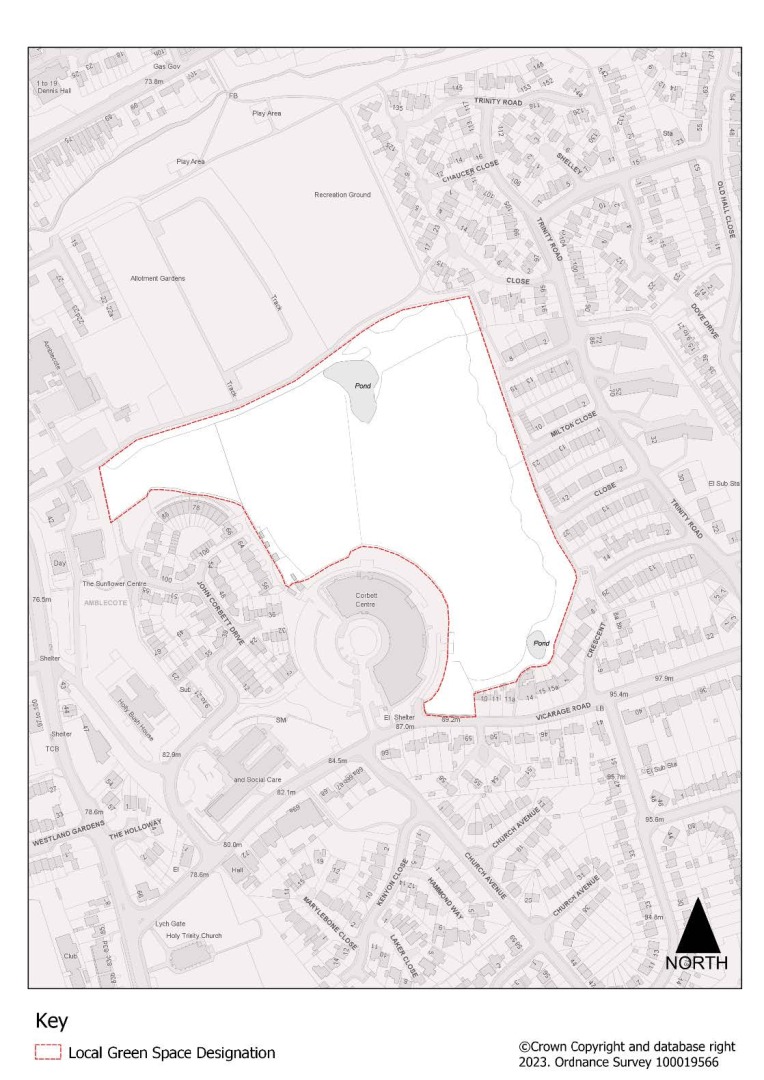
7.2Corbett Meadow is former parkland for the 18th century house called ‘The Hill’, which from c.1893 became Corbett Hospital. The Georgian mansion was erected c.1724 by John Grove, a local glass master. In the mid-18th century, it was occupied by Thomas Rogers, also a glass master. In the 19th century it was purchased by John Corbett, known locally as ‘The Salt King’ who in 1891 presented the house to the Trustees of Amblecote Urban District Council, together with an endowment of £20,000 for its use as an 18-bed hospital. The house was converted and extended by the Architect/Builder Thomas Robinson in 1892-93 who also erected the gate lodge, a brick and half-timbered building with plaster relief of the Corbett crest and iron gates.
7.3Corbett Meadow has significant heritage value, as a non-designated heritage asset due to its historic connections to prominent local figures and the history of glass making in the area. The site is included on the Sites and Monuments Record (HER reference: 7664). The meadow also has archaeological interest connected to the use of the site as Parkland and the original house which sat on the site.
7.4Whilst the principal House was demolished and its footprint subsequently developed c.2006, its associated parkland and trees still exist along with its gate lodge and iron entrance gates, both Locally Listed. The historic character and distinctiveness that this surviving landscape is derived from its past uses and its strong associations with people (now and through time) as well as from its existing visual features (two ponds, sweeping tracks of pasture, parkland trees, boundary treatments) and the spaces between.
7.5The site was designated a SINC in 2022 due to its high biodiversity value. The site comprises long-established pasture with mature standard trees (Wood-Pasture and Parkland-type habitat) with two ponds, one of which is of significant ecological value with records of breeding populations of three amphibian species. The site’s grasslands represent a rare surviving example of long-standing permanent grassland on semi-acidic Wildmoor Sandstone-derived soils, with a notable abundance of Pignut and Bluebells. The site is also part of a wider wildlife corridor providing connectivity within the urban area.
